


Panasonic's Aquarea is one of the most complete air-source heat pump ranges available in the UK today. It spans two refrigerants (R32 and the low-GWP R290), four platform families, both monobloc and hydro split configurations, and a full accessory ecosystem that lets installers pair it with just about any hot water cylinder or building management system.
This guide walks through everything you need to specify or install an Aquarea system: the refrigerant choice that governs which properties suit which unit, what actually differentiates Panasonic from the wider heat pump market, a model-by-model breakdown of the current UK line-up, how the controller architecture works, the growing Hydro Split option, and the accessories you'll need if you're pairing an Aquarea with a third-party cylinder.
R32 vs R290: which refrigerant, which house?
Every Aquarea heat pump uses one of two refrigerants — R32 (difluoromethane) or R290 (propane). Both are millions of times more climate-friendly than the R410A they replaced, but they behave differently, and the difference matters when you're matching a unit to a house.
Proven, efficient, versatile
GWP of 675 — around a third of R410A. Sealed factory charge in every Aquarea monobloc, so no on-site F-Gas brazing at install.
- Flow temperature ceiling: 60°C (J Generation) up to 65°C (T-CAP J Generation)
- Operating range: continuous heating down to −20°C ambient
- Best fit: new-build, well-insulated retrofits, systems paired with underfloor heating or low-temperature radiators
- UK availability: Aquarea J Generation Monobloc (5, 7, 9 kW single-phase) and T-CAP J Generation Monobloc (9, 12, 16 kW single/three-phase)
Ultra-low GWP, high flow temps
GWP of just 3 — effectively climate-neutral over the equipment's lifetime. Future-proof against tightening F-Gas regulation.
- Flow temperature ceiling: up to 75°C — matches many existing gas boiler flow temps
- Operating range: continuous heating to −20°C ambient with T-CAP capacity maintained down to −15°C
- Best fit: retrofits with existing radiators sized for a boiler, harder-to-insulate homes, cold-climate installs where flow temperature headroom matters
- UK availability: Aquarea M Series T-CAP Monobloc R290 (9, 12, 16 kW) and Aquarea L Series R290 Hydro Split (5, 7, 9 kW)
Real-world scenarios: how the choice plays out
| Property | Emitter type | Insulation | Best refrigerant | Reasoning |
|---|---|---|---|---|
| New-build 3-bed detached | UFH throughout | Excellent (Part L 2022+) | R32 (J Gen 5 or 7 kW) | UFH runs at 35–40°C flow. R32's 60°C ceiling is never used — you're paying for headroom you won't need. |
| 1990s 3-bed semi | Existing K-rad radiators | Good (topped-up loft, cavity fill) | R32 (T-CAP J Gen 9 kW) | 65°C flow ceiling reaches most existing rads without oversizing. T-CAP maintains output at −15°C without electrical booster. |
| Victorian 4-bed terrace | Existing radiators, no room to uprate | Partial (solid walls, limited IWI) | R290 (M Series T-CAP 12 kW) | 75°C flow ceiling lets existing rads deliver full duty without radiator replacement. The R290 unit essentially behaves like a gas boiler on flow temperature. |
| Rural stone cottage | Mixed rads + one UFH zone | Below average (thick walls, single glazing in places) | R290 (L Series Hydro Split 9 kW) | High flow temperature covers the rads on cold mornings; hydro split lets the noisy component sit outside while the hydraulic module goes in the utility room. |
| Modern flat conversion | New low-temp panel rads | Very good | R32 (J Gen 5 kW) | Smallest footprint, lowest cost, more than enough capacity and flow temperature. |
| Larger 5-bed with pool room | Rads + fan coils | Good but high demand | R32 (T-CAP J Gen 16 kW, three-phase) | Three-phase T-CAP handles peak load; T-CAP's capacity retention at low ambient matters more than R290's flow-temp advantage here. |
The insulation rule of thumb: R32 wins on cost and simplicity where flow temperatures can stay below 55°C. R290 wins where you can't drop the flow temperature — either because emitters are undersized for a heat pump or because the fabric can't be improved further. Neither is universally "better"; the correct answer comes from a proper heat loss survey.
What actually makes Panasonic Aquarea different
The UK heat pump market is crowded, so it's worth being specific about what distinguishes Aquarea from Mitsubishi, Daikin, Vaillant, and other credible options.
Aquarea Smart Cloud built in
Every current Aquarea unit is designed around the Aquarea Smart Cloud platform. Add the Wi-Fi adapter and homeowners get scheduling, energy monitoring and remote control; installers get remote diagnostics via Aquarea Service Cloud — cutting call-out costs and shortening fault resolution.
Heat Charge Function
Panasonic's predictive tank pre-heat learns your usage pattern and warms the DHW buffer ahead of demand. In practice this means less short-cycling, better seasonal efficiency, and less reliance on the immersion element during peak demand.
Dual-piped heat exchanger (T-CAP)
A Panasonic-patented refrigerant circuit that maintains nominal capacity down to −15°C without electrical backup — meaning no oversizing to cover the coldest weeks of the year. On the M Series R290, this extends to some of the highest low-ambient outputs in the market.
Modulating DC inverter
The compressor modulates continuously rather than cycling on and off, matching output to demand. On mild days this eliminates the noise and efficiency losses of short-cycling — a common complaint on fixed-speed heat pumps.
MCS certified & BUS grant eligible
The full UK Aquarea range is MCS certified and eligible for the £7,500 Boiler Upgrade Scheme grant when installed by an MCS-registered heat pump installer. The paperwork is straightforward and Panasonic maintain the certification centrally.
Multi-generation platform continuity
H, J, K, L and M generations share substantial platform DNA. Spare parts, controller compatibility and installer familiarity carry across generations — reducing lifetime maintenance cost and de-risking future component availability.
The Panasonic warranty picture
Every Aquarea outdoor unit ships with a 3-year manufacturer warranty as standard. That extends to up to 7 years parts and labour when installed and commissioned by a Panasonic-approved installer, provided the annual service is completed on schedule.
For BUS grant work the installer must be MCS-certified — the two designations often overlap in practice, but confirm both with your installer before commissioning.
The four current Aquarea families at a glance
The current UK Aquarea line-up divides into four families. Two run R32, two run R290; two are monobloc, one is a hydro split, and one straddles both in a bi-bloc configuration.
| Family | Refrigerant | Capacity | Max flow temp | Configuration | Typical use |
|---|---|---|---|---|---|
| Aquarea J Generation Monobloc | R32 | 5 / 7 / 9 kW (single-phase) | 60°C | Monobloc — single outdoor unit | New-builds and well-insulated retrofits, 2–4 bed homes |
| Aquarea T-CAP J Generation Monobloc | R32 | 9 / 12 / 16 kW (single & three-phase) | 65°C | Monobloc — single outdoor unit | Larger retrofit properties needing capacity retention at low ambient |
| Aquarea M Series T-CAP Monobloc R290 | R290 | 9 / 12 / 16 kW | 75°C | Monobloc — single outdoor unit | Retrofit with existing high-temp radiators; hard-to-insulate homes |
| Aquarea L Series R290 Hydro Split | R290 | 5 / 7 / 9 kW | 75°C | Hydro split — outdoor + indoor hydraulic module | Where the outdoor unit needs to be quieter or the hydraulic module has to sit indoors |
Watch: introducing the "Big" Aquarea T-CAP M Series R290

Panasonic's official introduction to the M Series T-CAP R290 — the R290 flagship covered in this guide. Watch on YouTube
The models in detail

J Generation R32 Monobloc — 5 / 7 / 9 kW
WH-MDC05J3E5 · WH-MDC07J3E5 · WH-MDC09J3E5
Panasonic's High Performance R32 monobloc for UK residential retrofit and new-build. Single-phase across the range. 60°C flow ceiling and A+++ seasonal efficiency at 35°C water. Built-in magnetic water filter, flow meter and auto air-purge valve reduce commissioning parts. Continues heating operation down to −20°C ambient.
From £3,100 Inc. VAT

T-CAP J Generation R32 Monobloc — 9 / 12 / 16 kW
WH-MXC09J3E5 and variants (single & three-phase)
The T-CAP designation ("Total Capacity") signals Panasonic's dual-piped heat exchanger, which maintains nominal output down to −15°C ambient without an electrical booster. 65°C flow temperature — high enough to keep many existing radiator systems working. Single-phase to 12 kW; three-phase for 9, 12 and 16 kW.
From £4,500 Inc. VAT

M Series T-CAP R290 Monobloc — 9 / 12 / 16 kW
WH-WXG09ME5 and variants
Panasonic's flagship R290 monobloc — GWP of 3, 75°C flow temperature ceiling, and the T-CAP capacity-retention advantage. This is the natural choice where existing radiators are sized for a gas boiler and cannot be uprated, or where the fabric limits how far the flow temperature can be reduced. Available in single and three-phase.
From £4,700 Inc. VAT

L Series R290 Hydro Split — 5 / 7 / 9 kW
WH-WDG05LE5 and variants (outdoor)
The R290 refrigerant advantage in a hydro split configuration — outdoor unit contains the compressor and heat exchanger; a separate indoor hydraulic module handles the water side. Ideal where the outdoor location favours a quieter compact unit, or where the plant room can accommodate an indoor hydraulic module for easier servicing. Requires either the Bi-Bloc or All-in-One indoor unit below.
From £3,100 Inc. VAT
The Aquarea Hydro Split explained
Most Aquarea units are monobloc — every component sits in a single outdoor cabinet and only water pipes cross the wall. The Hydro Split range splits that architecture: the compressor and evaporator stay outside, while the hydraulic module (pump, plate heat exchanger, expansion vessel and controls) moves indoors. Refrigerant pipes — not water pipes — connect the two.
Outdoor unit
Compressor, evaporator, fan and expansion valve. Smaller and generally quieter than an equivalent monobloc because the hydraulic components are elsewhere. R290 refrigerant runs in a sealed circuit between the outdoor unit and the indoor module.
Indoor hydraulic module
Contains the plate heat exchanger, circulation pump, expansion vessel, safety group and control PCB. Sits in a utility room, garage or airing cupboard — anywhere frost-free with drainage and power.
Refrigerant pipework
Copper refrigerant lines carry heat from outdoor to indoor. Installation requires F-Gas competent installers because the refrigerant circuit is jointed on site — unlike monobloc, which ships pre-charged and sealed.
System water side
Standard hydronic pipework leaves the indoor module and feeds radiators, UFH manifolds and (via a diverter valve) the DHW cylinder — exactly as with any monobloc.
Two indoor modules — Bi-Bloc or All-in-One

Hydro Split Bi-Bloc L Generation Indoor Unit
WH-SDC0509L3E5
Wall-mounted hydraulic module for the L Series Hydro Split heat pumps. Pairs with a separate cylinder — either a Panasonic Aquarea cylinder or a third-party unvented model with the accessories listed below. The right choice where cylinder location is constrained or a larger-than-standard tank is needed.
£1,360 Inc. VAT

Hydro Split All-in-One L Generation Indoor Unit
ADC0509L3E5UK
Floor-standing tower unit that combines the hydraulic module and a factory-integrated DHW cylinder in a single cabinet. The cleanest install where floor space is available: one plumbing connection to the outdoor unit, one plumbing connection to the heating circuit, and one to the mains. Ships pre-plumbed and pre-wired for fast commissioning.
£4,500 Inc. VAT
The controller architecture, module by module
Every Aquarea system is designed around a hierarchy of controllers — a base wired remote for direct control, a control module for larger units, and the Aquarea Smart Cloud Wi-Fi bridge for app and remote diagnostics. Understanding which one your install actually needs avoids buying (or missing) parts at commissioning.

M Series Control Module — Single-Phase 9 kW & 12 kW
WH-CME5
Wall-mounted control module for the single-phase M Series T-CAP R290 units. Provides the wired user interface, primary control logic and connectivity to buffer tanks, DHW sensors and zone actuators. Required for M Series installs.
£870 Inc. VAT
M Series Control Module — Three-Phase 9 kW to 16 kW
WH-CME8
Three-phase variant of the M Series control module — covers 9, 12 and 16 kW three-phase installations. Same feature set as the single-phase module but engineered around the three-phase electrical supply and higher-load protection.
£870 Inc. VAT

M Series Simple Wired Controller with Wi-Fi Adapter
CZ-RTW2TAW1C
Simplified wired user interface bundled with the CZ-TAW1C Wi-Fi bridge — the neatest solution where the homeowner wants both a physical wall thermostat and app control. Two SKUs in one box, saving on-site cabling and mounting time.
£570 Inc. VAT

Smart Cloud Wi-Fi Adapter — CZ-TAW2
CZ-TAW2
The current-generation Wi-Fi bridge for the Aquarea M Series and newer platforms. Adds full Aquarea Smart Cloud connectivity — scheduling, weather compensation tuning, energy monitoring, and remote installer access via Aquarea Service Cloud.
£215 Inc. VAT

Smart Cloud Wi-Fi Adapter for H Generation — CZ-TAW1C
CZ-TAW1C
Wi-Fi bridge for the H Generation platform and compatible earlier Aquarea units. Same Smart Cloud connectivity as the CZ-TAW2 but with the correct wiring for the earlier generation controller PCB — always confirm which one your outdoor unit expects before ordering.
£215 Inc. VAT

Modbus Interface — Intesis Hydro Unit Gateway
PAW-AW-MBS-H
Modbus RTU/TCP gateway for integrating Aquarea into a BMS or third-party building automation platform. Exposes the Aquarea data registers as standard Modbus points — essential for commercial installs, larger new-builds and any system that needs to talk to Priva, Trend, KNX bridges or bespoke controls.
£299 Inc. VAT

Options Board — Additional Functions PCB
CZ-NS4P
Add-on PCB that unlocks additional I/O on compatible Aquarea units — extra sensor inputs, dry-contact outputs for external circulator control, solar diverter interlock, and other custom integrations. Needed once your system exceeds the standard base-controller wiring capacity.
£215 Inc. VAT
Using Aquarea with a third-party cylinder
Panasonic offers its own 192L stainless-steel heat pump cylinder, but plenty of installs pair the Aquarea with a Telford, OSO, Joule, McDonald or Mixergy cylinder — often because the property already has one, or because the household needs more storage than the Panasonic tank provides. That's fully supported, but you need the right accessories to make the interface work correctly.
The four things any third-party cylinder pairing needs
- Heat-pump-suitable indirect coil: the cylinder needs a large-surface-area coil (typically 3 m² or more for a 200–250 L tank) so that heat can transfer at heat pump flow temperatures (45–55°C), not boiler flow temperatures (70–80°C).
- 3-way diverter valve: sits between the heat pump and the heating circuit / DHW coil. Panasonic units expect the diverter valve to be controlled by their onboard PCB.
- Tank temperature sensor: the Panasonic-format sensor connects into the Aquarea controller so the unit can regulate DHW correctly — a standard cylinder thermostat won't do the job.
- Anti-freeze protection on the primary flow and return: mandatory for monobloc installs. Two anti-freeze valves — one on flow, one on return — dump the primary water if power fails and the loop drops below 3°C, preventing pipework rupture.

Tank Sensor with 20m Cable
PAW-TS2
Panasonic-format temperature sensor with a 20-metre cable — long enough to reach from an outdoor unit or hydraulic module through to a cylinder in a plant room or airing cupboard. The correct plug and calibration for the Aquarea controller PCB.
£49 Inc. VAT
Buy Tank Sensor
Anti-Freeze Valve
PAW-A2W-AFVLV
Self-actuating drain valve that opens if the primary water temperature approaches freezing during a power cut. Two are typically required per monobloc install — one on flow and one on return. A cheap component that prevents a very expensive burst.
£135 Inc. VAT
Buy Anti-Freeze Valve
3-Way Diverter Valve (DHW)
PAW-3WYVLV-HW
Panasonic-format 3-way diverter valve for splitting primary flow between the heating circuit and the DHW coil. Wires directly to the Aquarea onboard PCB so DHW priority is handled by the heat pump controller — a hard requirement when pairing the Aquarea with a third-party cylinder.
£199 Inc. VAT
Buy Diverter Valve
Zone Water Sensor
PAW-A2W-TSHC
Additional water temperature sensor for a second heating zone — used in mixed UFH-and-radiator systems where each circuit runs at a different flow temperature, or where zoned weather compensation is needed. Wires directly to the Aquarea PCB or Options Board.
£53 Inc. VAT
Buy Zone Sensor
50L Buffer Volumiser
PAW-BTANK50L-2
50-litre in-line buffer tank sized for smaller Aquarea installs. Increases system water volume to prevent short-cycling and gives the defrost cycle a heat reservoir to draw from. A near-universal recommendation where system water volume is otherwise low.
£450 Inc. VAT
Buy 50L Buffer
L Series G3 Compliant Kit
PAW-G3KIT-1
Building Regulations G3-compliant safety kit for the L Series All-in-One unit — includes the expansion vessel, pressure relief valve and tundish arrangement needed to sign off a UK unvented DHW install. Order it with the All-in-One indoor unit.
£170 Inc. VAT
Buy G3 Kit
Aquarea 192L Cylinder
PAW-TD20C1E5UK-1
Panasonic's own 192-litre stainless-steel heat pump cylinder — arrives with the correct sensor pre-fitted and coil sized for Aquarea flow temperatures. The lowest-friction cylinder choice if you don't already have one on site.
£1,230 Inc. VAT
Buy 192L CylinderWatch: the Good Design Award-winning Aquarea K & L Generations
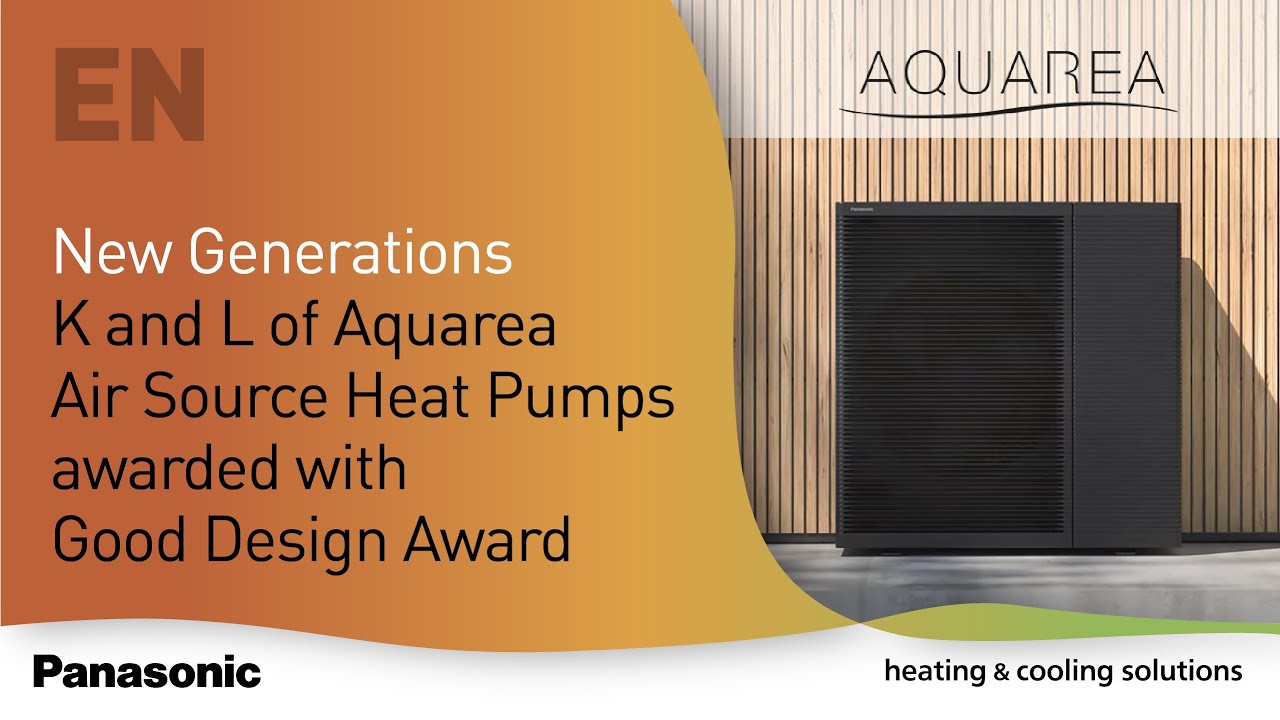
Panasonic's official overview of the design principles behind the current Aquarea K and L Generations. Watch on YouTube
Certifications & UK compliance
MCS Certified
Full UK Aquarea range covered under MCS HP0086
BUS Grant Eligible
£7,500 government grant with an MCS installer
ErP A+++ at 35°C
Top-tier seasonal efficiency rating
Good Design Award
K & L Generations recognised for engineering design
Common questions
Which Aquarea should I pick if my existing radiators are staying put?
If your existing radiators were sized for a gas or oil boiler running at 65–75°C, the R290 units (M Series T-CAP Monobloc or L Series Hydro Split) will let those emitters work correctly without replacement. If your rads are already low-temperature panels or you're happy to uprate a few, the R32 T-CAP J Generation gives you 65°C headroom at a lower purchase price. A heat loss survey per room will confirm which route is genuinely cheaper over the system's 15–20 year life.
Is R290 safe? I've heard it's flammable.
R290 is propane — it is flammable, but the refrigerant charge in a domestic heat pump is small (typically under 300 g), sealed in a factory-tested circuit, and mounted outdoors with defined clearance zones per the installation manual. Millions of R290 heat pumps operate safely across Europe. The regulations that installers follow (MIS 3005, BS EN 378) are specifically written to keep the refrigerant charge, ventilation and clearances within safe limits.
Do I have to buy the Wi-Fi adapter separately?
Yes — the Aquarea outdoor units ship with a wired remote controller. For Aquarea Smart Cloud app access, you'll need either the CZ-TAW2 (for M Series and later) or the CZ-TAW1C (for H Generation and earlier). Confirm which generation your outdoor unit is before ordering, since the two are not cross-compatible.
Can I install this myself?
Legally, competent DIY is possible for the monobloc units because there's no on-site F-Gas work — the refrigerant circuit is factory-sealed. However, to claim the £7,500 Boiler Upgrade Scheme grant and to preserve the extended manufacturer warranty, the unit must be installed and commissioned by an MCS-certified heat pump installer. The commissioning documentation and MCS paperwork are what gets you the grant.
Which Aquarea is best for a low-noise install near a bedroom window?
The Hydro Split configuration puts the compressor and fan in a physically smaller outdoor unit — noise output is generally lower than an equivalent monobloc because the hydraulic components sit indoors. For a very quiet install, the L Series R290 Hydro Split paired with careful outdoor unit siting (away from reflective walls, on rubber anti-vibration mounts, on a solid base) is Panasonic's quietest current option in the residential range.
Do I need the Modbus gateway for a normal home install?
No — the Modbus gateway (PAW-AW-MBS-H) is for BMS integration on larger properties, multi-dwelling projects, or homes with a central automation platform (Loxone, KNX, home-brew HA installs). A standard residential install uses the wired controller and, optionally, the Smart Cloud Wi-Fi adapter. Skip the Modbus gateway unless you have a specific integration requirement.
Explore related product ranges & guides
- Browse all heat pumps at AIZO Quality Heating
- Heat pump cylinders — dedicated coils for low-temperature systems
- Heat pump buffer tanks — sized to prevent short-cycling
- Heat pumps FAQ — installation, running costs, savings
- Panasonic product collection — the full Aquarea range at AIZO
- Request a custom quote — MCS install partners across the UK
Specifying an Aquarea system?
Whether you're an installer sizing your first Panasonic install or a homeowner deciding between R32 and R290, we'll help you specify the right unit, cylinder, buffer and controls the first time.