


"Low water pressure" is one of the most common call-outs a plumber gets — and one of the most commonly misdiagnosed. A customer says the shower is weak, a new combi is quoted, a pump is fitted, and three weeks later the complaint comes back. Nine times out of ten the problem wasn't the product. It was that nobody measured the water before choosing it.
Improving water pressure properly means answering three questions on site: how much pressure the supply has (static and under load), how much flow it can actually deliver in litres per minute, and how hard the water is. Those three numbers decide whether you need a mains booster pump, a shower pump, an accumulator, a bigger gas combi, a higher-output electric combi — or simply scale protection and a clean-out.
This guide is written for plumbers, heating engineers and installers. It walks through how to take those readings in minutes with the Salamander AquaScan 4-in-1 Digital Water Multimeter, how to interpret them, and which products from the AIZO Quality Heating range fit each result.
Why Pressure Alone Doesn't Diagnose a Water Problem
Most engineers carry a pressure gauge. Far fewer measure flow — yet flow is what the customer feels. A property can show a healthy static pressure with every tap closed and still collapse to a trickle the moment two outlets open, because an undersized or furred-up supply pipe can't deliver the volume. Equally, a home can have modest pressure but plenty of flow, which a combi will happily work with.
Static pressure
The reading with all outlets closed. Useful, but on its own it flatters the supply — it says nothing about what happens under demand.
Dynamic (working) pressure
The pressure that remains while water is flowing at a set rate. A big drop between static and dynamic points to restriction: undersized pipe, a part-closed stop-tap, scale or a shared supply.
Flow rate (L/min)
The number that sizes combis, booster pumps and scale conditioners. Manufacturers quote hot water output in litres per minute — you need the supply figure to match it.
Hardness (ppm)
In hard water areas scale insulates heat exchangers, sticks valves and chokes aerators. Above 200 ppm, Part L expects treatment on the cold feed to a combi's hot water circuit.
The AquaScan: Four Site Instruments in One Case
The Salamander AquaScan is a handheld digital water multimeter that reads flow, pressure, temperature and a hardness indication (TDS) from a single connection. It is used at an outlet — no permanent installation, no cutting into pipework — and it works on any installation; you don't need a Salamander pump to use it. A clear display shows live and peak values, the waterway is solid brass with an integral isolation valve, and it charges over USB-C for around 12 hours of use.

Salamander Pumps
AquaScan 4-in-1 Digital Water Multimeter
Measure pressure (0–10 bar), flow (0–30 L/min), temperature (0–85 °C) and a TDS hardness indication (0–1000 ppm) in one survey. Supplied in a robust carry case with connectors for taps, mixers, aerators, showers, hoses and 15/22 mm pipework, plus a specification notepad for recording results.
Winner of the Pump Industry Awards 2025, iF Design Award 2025 and HPM Awards 2025 Most Innovative Plumbing Product. Made in the UK.
£395.00 Inc. VAT (£329.17 Exc. VAT)
A 15-minute water survey with the AquaScan
Incoming mains flow
Connect to the outside (garden) tap, fully open the AquaScan isolation valve and take three readings from the live flow display; average them. No outside tap? Open several outlets, keep them all running and add the flow at each.
Static pressure
Let water flow through, then close the AquaScan valve and make sure every outlet in the property is closed. Read the pressure. This is your "best case" figure.
Dynamic pressure
Fully open the valve and open the outlet until you reach the flow the appliance needs (for example 10–12 L/min for a combi shower). The pressure that remains is what the boiler or pump will actually see.
Temperature & hardness
Close the lever so the water is static and wait at least 30 seconds for a TDS reading — test before any existing softener. For hot water, discharge into a basin and run 30–60 seconds for a stable temperature.
Safety and accuracy notes: before removing the AquaScan, close the outlet and confirm the display reads 0.0. When testing hot water (up to 85 °C) discharge into a suitable container to avoid scalding. TDS is a hardness indication, not a full chemical analysis — where the reading is high, confirm with your water supplier's published hardness data or a lab analysis before specifying treatment. The unit shows live and peak values but does not log data, so record results in the supplied notepad.
See the AquaScan in action

AquaScan 4-in-1 Digital Water Multimeter — animation. Watch on YouTube
How AquaScan readings help you do the job better
- Quote with evidence. Write the static/dynamic pressure, flow and ppm on the quote. Customers accept a booster pump or a larger boiler far more readily when they can see the numbers.
- Size first time. Match combi hot-water output, pump duty and scale-conditioner flow range to a measured figure rather than a pipe size — fewer returns, fewer call-backs.
- Prove the fix. Take a before-and-after reading at the same outlet. A documented improvement closes the job and protects you if the complaint resurfaces.
- Spot the real culprit. A large static-to-dynamic drop points to restriction or scale, not a weak mains — often a cheaper repair than new equipment.
- Evidence for the water company. Recorded readings at the stop-tap support a pressure or flow complaint where the supply itself is inadequate.
From Reading to Recommendation: A Quick Decision Table
Use this as a starting point once you have your AquaScan figures. Always confirm against the product manufacturer's installation requirements and the Water Supply (Water Fittings) Regulations.
| What the AquaScan shows | Likely cause | Typical solution |
|---|---|---|
| Good static pressure, big drop under flow | Restricted or undersized supply, part-closed stop-tap, scale build-up | Check valves and pipework first; descale or treat; then consider an accumulator or mains booster |
| Low pressure and low flow on direct mains, combi property | Weak incoming mains | Inline mains booster pump (e.g. Stuart Turner Stormboost) — or a break-tank system for larger demand |
| Weak shower on a gravity-fed (tank) system | Insufficient head from the loft tank | Positive head shower pump (Salamander CT50 Xtra) or a negative head/universal pump where flow is very low |
| Flow fine at one outlet, collapses with two open | Peak demand exceeds what the supply can deliver | Accumulator vessel to store mains water for peaks, or a higher-capacity booster set |
| Combi hot water weak but cold flow adequate | Boiler hot-water output too low for demand (common with low-kW electric combis) or scaled plate heat exchanger | Re-size the combi to the measured flow; descale and fit scale protection |
| TDS / hardness above ~200 ppm | Hard water area | Scale inhibitor or water conditioner on the cold feed (Part L requirement for combis in hard water areas); softener for whole-house treatment |
Improving Mains Water Pressure: Booster Pumps for Mains and Taps
Once you know the supply is genuinely weak — not just restricted — a pump is the most direct fix. The key is choosing the right type for the system the AquaScan has just told you about.
For direct mains and combi properties
The Stuart Turner Stormboost (47708) installs inline on the rising main after the internal stop-tap and boosts mains pressure by up to 2.5 bar, delivering up to 12 L/min. It switches on automatically once flow exceeds 0.6 L/min, so the AquaScan flow test at the stop-tap tells you straight away whether it will activate. A patented integral bypass passes water straight through when mains flow is sufficient, so the pump never throttles the supply. It is WRAS approved and Kiwa Reg 4 certified, with a 5-year warranty on registration — ideal for a one-bathroom combi home with poor mains pressure.
Regulation reminder: a Type EC verifiable double-check valve must be fitted on the inlet, inlet pressure must not exceed 6 bar (fit a PRV if it does), and the electrical connection needs a 5A fused spur and 30 mA RCD. Pumps drawing directly from the mains at more than 12 L/min (0.2 litres per second) require notification to the water undertaker — the Stormboost's 12 L/min maximum sits within that threshold.
For gravity-fed systems, showers and taps
Where hot and cold come from a cylinder and loft tank, a mains booster is the wrong tool. The Salamander CT50 Xtra is a 1.5 bar twin-impeller regenerative pump that boosts both hot and cold to a single thermostatic mixer shower. It needs at least 2 L/min of natural flow on each side (4 L/min mixed) — exactly what the AquaScan flow reading confirms — and runs quietly at 52.5 dBA with Quiet Mark approval. It must never be connected to the mains or used with a combi or unvented cylinder.

Stuart Turner
Stormboost Mains Water Booster Pump 2.5 Bar — 47708
Automatic inline mains booster for combi homes with low incoming pressure. Up to +2.5 bar and 12 L/min, patented bypass, anti-seize and dry-run protection, solid brass head. WRAS approved, made in Britain.
£370.00 Inc. VAT

Salamander Pumps
CT50 Xtra 1.5 Bar Twin Positive Head Pump
Salamander's best-selling shower pump for gravity-fed systems. Boosts hot and cold to one mixer shower — 1.3 bar at 8 L/min, 1.0 bar at 16 L/min — with push-fit anti-vibration hoses and a 3-year warranty.
£165.00 Inc. VAT
Other booster options by application
| Model | Application | Key figure | Price (inc. VAT) |
|---|---|---|---|
| Salamander HomeBoost | Intelligent inline mains booster, WRAS approved | 1.6 bar boost | £390.00 |
| Salamander CT55 Xtra | Single-impeller positive head pump — boosts one supply on a gravity system | 1.5 bar | £170.00 |
| Salamander CT Force 20SU | Universal (negative/positive head) single shower pump for low-flow gravity systems | 2.0 bar | £370.00 |
| Stuart Turner Monsoon Professional | Variable-speed centrifugal booster for multi-bathroom homes | 78 L/min, 4.2 bar | £630.00 |
| Salamander AccuBoost 330L | Unpumped accumulator — stores mains water to cover peak demand | 330 L store | £1,395.00 |
| Salamander TankBoost 200L | Break-tank and pump set for whole-house boosting where mains flow is inadequate | 3.0 bar | £1,590.00 |
Useful accessories: the Salamander Water Starvation Protection (WSP) kit (£139.00) protects pumps against dry running, and the Salamander Noise Reducing Pump Mat (£47.00) cuts structure-borne noise. Browse the full water pressure booster pumps collection for Stuart Turner, Salamander and Grundfos options.
Flow Rates and Combi Boilers: Size the Boiler to the Supply
A combi heats water as it flows, so its hot-water performance is limited by two things: the boiler's output (kW) and the cold supply feeding it. Fit a combi rated at 13 L/min onto a supply that only delivers 9 L/min and the customer will only ever get 9. Fit a low-output combi onto a strong supply and the water will run lukewarm. The AquaScan flow reading at the stop-tap or garden tap is therefore the first number to write down on any combi quote.
Gas combi boilers: generous flow, but only if the mains can feed it
Gas combis quote hot-water flow at a 35 °C temperature rise. In the AIZO range, outputs run from around 12 L/min for a one-bathroom home to 18 L/min for larger properties. As a rule, check that your measured mains flow comfortably exceeds the boiler's rated figure, and that dynamic pressure at that flow stays above the boiler's minimum working pressure (for example 0.7 bar on the Vaillant ecoTEC Plus 832).

Worcester Bosch
Greenstar 4000 30kW Combi Boiler
Compact A-rated combi for flats and one-bathroom homes. 12.3 L/min at a 35 °C rise, 24 kW heating output and a 7-year warranty.
£1,595.00 Inc. VAT

Vaillant
ecoTEC Plus 832 Gas Combi Boiler
32 kW combi with IoniDETECT and 1:10 modulation. 13.0 L/min at a 35 °C rise, minimum operating pressure 0.7 bar and minimum flow 2.0 L/min — ideal for two-bathroom homes.
£1,995.00 Inc. VAT

Worcester Bosch
Greenstar 8000+ 45kW Combi Boiler
Worcester's most powerful combi: 18.0 L/min at a 35 °C rise for larger homes with simultaneous showers and taps. Only specify it where the AquaScan confirms the mains can deliver that flow.
£2,700.00 Inc. VAT
Electric combi boilers: why flow rate matters even more
With an electric combi the limiting factor is usually the boiler, not the mains. Every litre of hot water needs a fixed amount of energy, so the instantaneous hot-water flow is set almost entirely by the kW rating and the temperature rise from the incoming cold. That's where the AquaScan temperature reading earns its keep: winter mains water in the UK is often well under 10 °C, so the rise needed for a 40–45 °C shower is 30–35 °C.
As a rule of thumb, hot-water flow (L/min) ≈ kW × 14.3 ÷ temperature rise (°C). Note that electric combi manufacturers often quote at a 30 °C rise, while gas combis are quoted at 35 °C — compare like with like.
| Electric combi output | Approx. flow at 30 °C rise | Approx. flow at 35 °C rise | Realistic use |
|---|---|---|---|
| 7 kW | ~3.3 L/min | ~2.9 L/min | Basins only / very low hot water demand |
| 11 kW | ~5.3 L/min | ~4.5 L/min | Small flat, low-flow shower |
| 14–14.4 kW (single phase) | ~6.7–6.9 L/min | ~5.7–5.9 L/min | Practical minimum for one comfortable shower |
| 18 kW (three phase) | ~8.6 L/min | ~7.4 L/min | Larger home, better shower performance |
| 24 kW (three phase) | ~11.5 L/min | ~9.8 L/min | Approaching gas-combi shower performance |
Installer tip: on an electric combi job a strong mains reading can mislead the customer — the boiler, not the supply, caps the shower. Use the AquaScan to show the incoming cold temperature, explain the kW-to-flow trade-off up front, and consider a flow restrictor (ThermoSphere supplies a 5 L/min Caleffi valve in its installation kit) so the temperature stays stable on the coldest days. Confirm the consumer unit can take the load: a 14 kW unit needs a dedicated 63A circuit and 10 mm² cable.

ThermoSphere
Flex Electric Combi Boiler 4–14kW (TSFLEX14)
Digitally adjustable 4–14 kW heating and 10–14 kW hot water. Delivers about 6 L/min at a 30 °C rise — right for one-shower flats and off-gas homes. Pre-wired, pre-plumbed, 30 dB and up to 7 years' warranty with the installation kit.
£1,170.00 Inc. VAT

Strom
AuraHeat 9kW Stored Electric Combi (SBSP9SC)
Recirc Technology pre-heats water in a 35 L stainless tank, so the boiler sustains around 10 L/min at a 30 °C rise when charged — and up to 7 L/min even when depleted. The answer when an electric property needs gas-like flow on a single-phase supply.
£2,670.00 Inc. VAT
Electric combi comparison: hot-water flow at a glance
| Model | Supply | Manufacturer DHW flow | Price (inc. VAT) |
|---|---|---|---|
| ThermoSphere Flex 4–14kW | Single phase, 63A | ~6 L/min at 30 °C rise (14 kW) | £1,170.00 |
| Biasi Pro-Electric 14kW | Single phase | Up to 7 L/min | £1,095.00 |
| Strom 14.4kW (SBSP15C) | Single phase | 7 L/min at 30 °C rise | £1,330.00 |
| Elterm Ensign 9kW CH / 14kW DHW | Single phase | Separate 14 kW hot-water rating | £1,870.00 |
| Strom 24kW (SBTP24C) | Three phase | 12 L/min at 30 °C rise | £1,470.00 |
| Strom AuraHeat 9kW (stored) | Single phase, 50A | 10 L/min at 30 °C rise (tank charged) | £2,670.00 |
| Strom AuraHeat 13.5kW (stored) | Single phase, 63A | 12 L/min at 30 °C rise (tank charged) | £2,770.00 |
See the full ranges of electric combi boilers and A-rated gas combi boilers.
Water Hardness: Protect the Flow You've Just Fixed
Scale is the slow enemy of water pressure. It narrows pipework, chokes aerators and shower heads, sticks diverter valves and coats combi plate heat exchangers and electric elements — and every millimetre of it cuts efficiency. Once the AquaScan TDS reading points to hard water, treatment belongs on the job sheet.
As a guide, water above 200 ppm is hard enough to warrant active protection and above 300 ppm is very hard. Part L of the Building Regulations expects the feed to water heaters and the hot-water circuit of combination boilers to be treated in hard water areas (above 200 ppm). Size conditioners to the measured flow, not just the pipe diameter — another reason to take the AquaScan flow reading first.
Scale inhibitors and water conditioners

Aquabion
S15 Water Conditioner — 15mm, Salt-Free
Whole-house galvanic zinc-anode conditioner for 15 mm mains and 1–2 showers at a time. No salt, chemicals or power, 1–18 L/min operating range, 0.02 bar pressure drop and a 7-year service life. WRAS approved and safe for drinking water.
£430.00 Inc. VAT

ADEY
ElectroScale2 22mm Scale Reducer (SR1-03-05233)
Fit-and-forget electrolytic scale reducer for the incoming cold main. Up to 36 L/min with just 44 mbar drop, no power or maintenance, 10-year design life. WRAS approved and Part L compliant for combi cold feeds.
£65.00 Inc. VAT

Stuart Turner
C23-45 Catalytic Water Conditioner — 22mm
Catalytic-core conditioner selected by measured flow: the C23-45 covers 23–45 L/min for larger properties. Stainless steel, 10 bar, no power or chemicals, roughly 15-year active life and a 10-year warranty.
£250.00 Inc. VAT
For 22 mm mains with 2–4 simultaneous showers, step up to the Aquabion S20 (£650.00); for point-of-use protection under a single boiler, the ADEY MagnaScale2 15mm (£47.95) is a low-cost option. Browse all scale inhibitors and water treatment from Aquabion, ADEY and Kamco.
Water softeners and filters: when conditioning isn't enough
Conditioners change how scale behaves; softeners remove the hardness minerals altogether. Where the AquaScan TDS reading is very high, where the customer wants softer water at every tap, or where appliances and showers are scaling quickly despite treatment, a whole-house softener is the more complete answer. Size the softener to the measured peak flow so it doesn't become a new restriction, keep an unsoftened drinking-water tap, and fit a bypass valve for servicing. Explore water softeners, filters and limescale solutions for the full range.
AquaScan Full Technical Specification
| Specification | AquaScan (Part no. AQUASCAN) |
|---|---|
| Pressure range | 0–10 bar, accuracy 1.5% of full scale |
| Flow range | 0–30 L/min, accuracy 5% of reading |
| Temperature range | 0–85 °C, accuracy 1.25% of full scale |
| TDS (hardness indicator) | 0–1000 ppm, accuracy 10% of reading |
| Display | Live and peak readings, three selectable layouts, reset button |
| Inlet / outlet | ¾" female inlet / ¾" male outlet, brass waterway with integral isolation valve |
| Battery | 2400 mAh lithium polymer, approx. 12 hours per charge, USB-C (up to 7 hours to charge) |
| Auto shut-off | 20 minutes |
| Enclosure protection | IPX5 |
| Unit dimensions / weight | 180 × 125 × 80 mm (with valve) / 1 kg |
| Case with contents | 370 × 300 × 170 mm / 4.2 kg |
| Media | Clean, potable water only |
| Warranty / origin | 1 year / Made in the UK |
What's in the AquaScan case
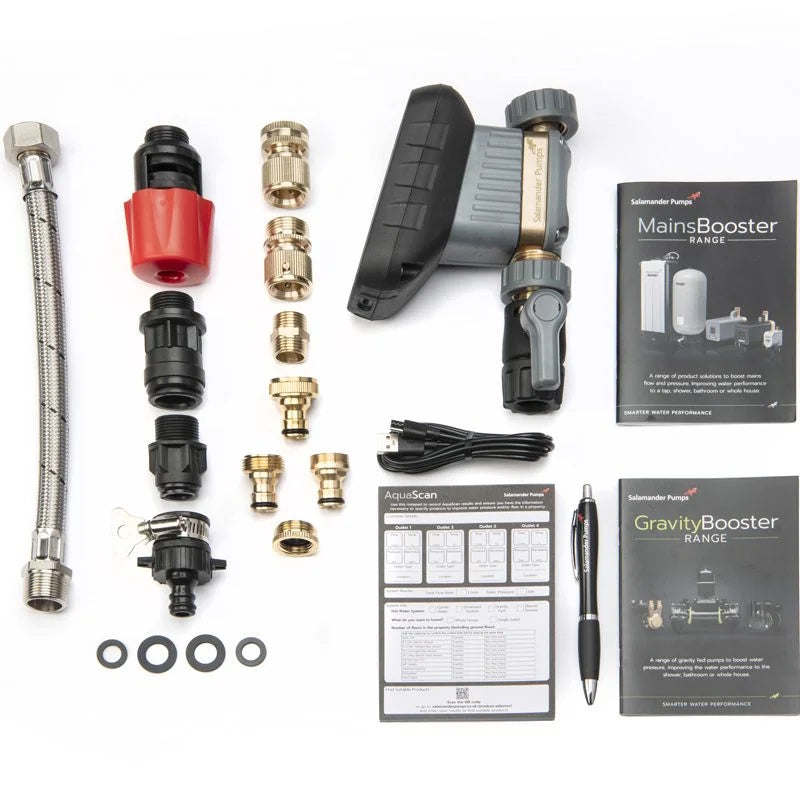
The unit with integral isolation valve; a 1 m USB-C cable; ¾" male and female hose quick connectors; 15 mm and 22 mm push-fit to ¾" male adaptors; mixer tap and single tap hose connectors; a ¾" to ½" adaptor and ½" male-to-male connector; washers; a 300 mm flexible hose; male and female aerator thread connectors; and a specification notepad. In short, everything you need to connect to a tap, mixer, shower or exposed pipe without improvising.
Awards and approvals
Frequently Asked Questions
How do I measure the flow rate of my mains water supply?
Connect a flow meter such as the AquaScan to the outside tap, open its isolation valve fully, take three live flow readings and average them. If there is no outside tap, open several outlets, keep them running and add the flow at each. Measuring at the point closest to the incoming main gives the truest picture of what the supply can deliver.
What is the difference between water pressure and flow rate?
Pressure (bar) is how hard the water is pushed; flow rate (litres per minute) is how much water arrives. A property can have acceptable static pressure but poor flow if the supply pipe is undersized or restricted. Combi boilers, booster pumps and scale conditioners are all sized on flow, so you need both readings.
What flow rate does a combi boiler need?
Enough to match the boiler's rated hot-water output. Gas combis in the AIZO range deliver roughly 12–18 L/min at a 35 °C rise, so the mains should comfortably supply at least that. Electric combis are limited by their kW rating — a 14 kW unit gives around 6–7 L/min at a 30 °C rise regardless of how strong the mains is.
Will a booster pump work with my combi boiler?
Yes, if you use a WRAS-approved mains booster such as the Stuart Turner Stormboost, which is designed for direct-mains combi homes. It needs at least 0.6 L/min of unassisted flow to switch on, inlet pressure below 6 bar, and a double-check valve on the inlet. Shower pumps like the CT50 Xtra are for gravity-fed systems only and must never be connected to a combi or the mains.
How accurate is a TDS reading for water hardness?
TDS gives a reliable indication of hardness on site, and the AquaScan reads 0–1000 ppm to within 10% of the reading. It is not a full mineral analysis, so where results are high, confirm with your water supplier's published hardness data or a laboratory test before specifying treatment. Always test before any existing softener and with the water static.
Do I need scale protection on a new combi boiler?
In hard water areas (above about 200 ppm) Part L expects the feed to the combi's hot-water circuit to be treated, and many manufacturers require it for warranty. A WRAS-approved device such as the ADEY ElectroScale2 or an Aquabion conditioner on the cold main is a common, low-maintenance way to comply.
Measure first. Fit once. Get it right.
Add the AquaScan to your van kit and quote every water pressure, combi and scale job on measured flow, pressure and hardness. Need help sizing a booster pump, combi or conditioner from your readings? The AIZO Quality Heating team is here for trade and homeowners alike.