


Every car park in the UK is becoming a potential refuelling point. Whether you run a motorway-side hotel, a retail park in Milton Keynes, a GP surgery in Leeds or a 20-van fleet depot outside Birmingham, drivers now expect to plug in while they park — and the businesses that offer it are winning the footfall, the longer visits and the loyalty.
But "EV charger" covers everything from a £395 wall-mounted unit to a half-tonne, 240kW rapid charging station. Picking the right one depends on three questions: how long do drivers stay, what electrical supply do you have, and do you want to sell the electricity or simply provide it? This guide from AIZO Quality Heating explains AC and DC charging, single-phase and three-phase supplies, which charger suits which type of site, and the commercial benefits of adding charge points — with the exact units we supply for each scenario.
AC vs DC Charging: What's the Difference?
Every EV battery stores energy as direct current (DC), but the grid delivers alternating current (AC). Somewhere between the supply and the battery, AC has to be converted to DC. The key difference between AC and DC chargers is where that conversion happens.
Conversion inside the car
An AC charger (often called a wallbox or "destination charger") safely supplies AC power to the vehicle. The car's own onboard charger converts it to DC. Because the onboard charger is small, power is limited — typically 7kW to 22kW.
- Low cost — from a few hundred pounds per point
- Works on normal single- or three-phase supplies
- Ideal where cars park for 2+ hours
- Type 2 connector (UK & European standard)
Conversion inside the charger
A DC rapid or ultra-rapid charger contains its own large rectifier. It converts AC to DC before it reaches the car and feeds the battery directly, bypassing the onboard charger. That's how it reaches 40kW, 120kW or even 240kW.
- Adds hundreds of miles in minutes, not hours
- Needs a substantial three-phase 400V supply
- Ideal where stays are 5 to 60 minutes
- CCS2 connector (CHAdeMO optional on some units)
How a charging session works
Grid supply
AC power arrives from your distribution board — single-phase 230V or three-phase 400V.
Handshake & authorisation
Charger and car agree a safe current. Drivers start with an RFID card, app, contactless terminal or Plug & Charge (ISO 15118).
AC to DC conversion
On AC units the car's onboard charger converts the power; on DC units the station does it, at far higher power.
Metering & management
An OCPP back office logs kWh, bills the driver or allocates cost, and balances load so the site supply is never overloaded.
Single-Phase vs Three-Phase: Why Your Supply Decides Your Charger
Most UK homes and many small shops have a single-phase supply (one live conductor at 230V). The most an AC charger can deliver on single-phase is 7.4kW (230V × 32A). Most commercial and industrial premises — offices, warehouses, hotels, schools, farms with machinery — have a three-phase supply (three live conductors at 400V between phases). Three-phase lets an AC charger deliver up to 22kW (3 × 230V × 32A), and it is a must for any DC rapid charger.
| Supply | Max AC charger output | Approx. miles added per hour* | Typical premises |
|---|---|---|---|
| Single-phase 230V | 7.4kW (32A) | 25–30 miles | Small shops, cafés, B&Bs, surgeries, HMOs, homes |
| Three-phase 400V (16A) | 11kW | 35–45 miles | Offices, schools, small industrial units |
| Three-phase 400V (32A) | 22kW | 60–90 miles** | Hotels, retail parks, depots, leisure centres, hospitals |
| Three-phase 400V (high capacity) | DC 40–240kW | 165+ miles (40kW) up to ~250 miles in 15 min (240kW) | Service stations, mobility hubs, supermarkets, fleet depots |
*Indicative, based on a typical efficiency of 3.5–4 miles per kWh. **Only if the vehicle's onboard charger accepts 22kW AC — many EVs cap AC charging at 11kW or 7kW.
⚡ The 22kW Question Every Business Should Ask
A 22kW AC charger is a brilliant, affordable workhorse — but it only delivers 22kW if both your site and the car can handle it. Plenty of popular EVs have 11kW onboard chargers, so they'll charge at 11kW on a 22kW unit. That's still two to three times faster than a 7kW point and perfect for 2–4 hour stays.
If your visitors stop for under an hour — coffee, fuel, a quick shop — no AC charger will give them a meaningful top-up. That's where DC comes in: a 40kW VEGA Gravity adds around 165 miles in an hour, and a 240kW Lander Plus can add roughly 250 miles in 15 minutes.
Rule of thumb: stays under 1 hour → DC. Stays of 1–4 hours → 22kW AC. All-day or overnight → 7kW AC is usually enough.
Who Should Install Which Charger? Applications by Sector
From market towns in the Cotswolds to business parks on the edge of Manchester, the best charging setup is dictated by dwell time. Here's how we match chargers to the sites that ask us most often.
🛣️ Service stations & mobility hubs
Motorway and A-road service areas on the M1, M6, A1 and M25 corridors, fuel forecourts and dedicated charging hubs need to turn bays over fast.
Best fit: VEGA Lander Plus 160–240kW
🛒 Supermarkets & retail parks
A 30–60 minute shop is the perfect window for DC charging — and a strong reason to choose your store over the one down the road.
Best fit: VEGA Lander 60kW or Lander Plus 120kW
🏨 Hotels, pubs & restaurants
Overnight guests in the Lake District, Peak District or Scottish Highlands want a full battery by breakfast; diners want a boost during a two-hour meal.
Best fit: 22kW AC (Sigenergy / SolarEdge) + VEGA Gravity 40kW
🏢 Offices & workplaces
Staff are parked for 7–9 hours, so slower AC charging is ideal. RFID and OCPP let you allocate or recharge the cost fairly.
Best fit: Fox 7kW commercial or 22kW AC wallboxes
🚐 Fleet depots & logistics
Van fleets, delivery operators, trades businesses and car-share schemes need predictable, managed charging between shifts.
Best fit: 22kW AC for overnight + VEGA 60–120kW for rapid turnaround
🚕 Taxi & private hire
With London's taxi licensing requiring zero-emission-capable vehicles and other cities following, operators need fast top-ups between fares.
Best fit: VEGA Gravity 40kW or Lander 60kW
🏥 NHS trusts, councils & public sector
Hospitals, GP surgeries, council offices, libraries and leisure centres serve staff, patients and visitors with mixed stay lengths.
Best fit: Mix of 22kW AC and 40–60kW DC
🎓 Universities, colleges & schools
Campus car parks, staff bays and minibus fleets suit networked AC charging with access control and metered billing.
Best fit: SolarEdge 22kW RFID/MID or Fox 7kW commercial
⛳ Leisure & tourism
Golf clubs, gyms, garden centres, farm shops, visitor attractions, marinas and holiday parks — visits of 1–4 hours are made for 22kW AC.
Best fit: Sigenergy 22kW (4G, no Wi-Fi needed)
🏘️ Landlords, HMOs & residential blocks
Shared car parks need RFID access and a certified MID meter so each resident can be billed accurately for the electricity they use.
Best fit: SolarEdge 22kW RFID/MID or Fox 7kW commercial
Quick Selector: Match the Charger to Your Site
| Typical stay | Example sites | Recommended charger | Type / supply |
|---|---|---|---|
| 5–20 minutes | Motorway services, forecourts, charging hubs | VEGA Lander Plus 240kW / 160kW | DC · high-capacity 3-phase |
| 15–45 minutes | Supermarkets, drive-thrus, retail parks | VEGA Lander Plus 120kW / Lander 60kW | DC · 3-phase |
| 30–90 minutes | Restaurants, cafés, taxi ranks, gyms | VEGA Gravity 40kW | DC · 3-phase (65A) |
| 1–4 hours | Hotels, pubs, leisure, attractions, hospitals | Sigenergy EVAC 22 / SolarEdge 22kW | AC · 3-phase |
| 4–10 hours | Offices, depots, schools, residential blocks | Fox 7kW commercial / SolarEdge 7.4kW / 22kW AC | AC · single or 3-phase |
The Benefits of Offering EV Charging at Your Business
💷 A new revenue stream
Chargers with OCPP back-office support and contactless payment let you sell electricity at a margin. DC rapid charging in particular commands premium per-kWh pricing from public drivers.
🛍️ Longer visits, bigger baskets
Drivers who plug in stay put. That extra 30–60 minutes translates into more coffee, more food orders and more time in-store — and a reason to choose you over a competitor without chargers.
🧭 Visibility on charging maps
Public charge points appear on the route-planning apps EV drivers use daily. For a rural pub, farm shop or independent hotel, that's free marketing to a high-spending audience.
🚐 Lower fleet running costs
Charging vans and pool cars on site — especially overnight on a business off-peak tariff or from your own solar PV — is far cheaper per mile than diesel or public rapid charging.
👥 Staff attraction & retention
Workplace charging is now an expected perk, and it supports electric company-car and salary-sacrifice schemes that staff increasingly ask for.
🌱 ESG, compliance & property value
Charge points support carbon-reduction reporting and sustainability credentials. In England, Building Regulations Part S already requires charge points and cable routes in many new and major-renovation non-residential car parks — installing now future-proofs your site and adds value to the property.
Grant funding and tax treatment for charge points change regularly. Check current OZEV schemes (such as workplace charging support) and ask your accountant about capital allowances before you buy — they can materially reduce the net cost of a commercial installation.
Commercial DC Charging Stations: The VEGA ALOHA Range
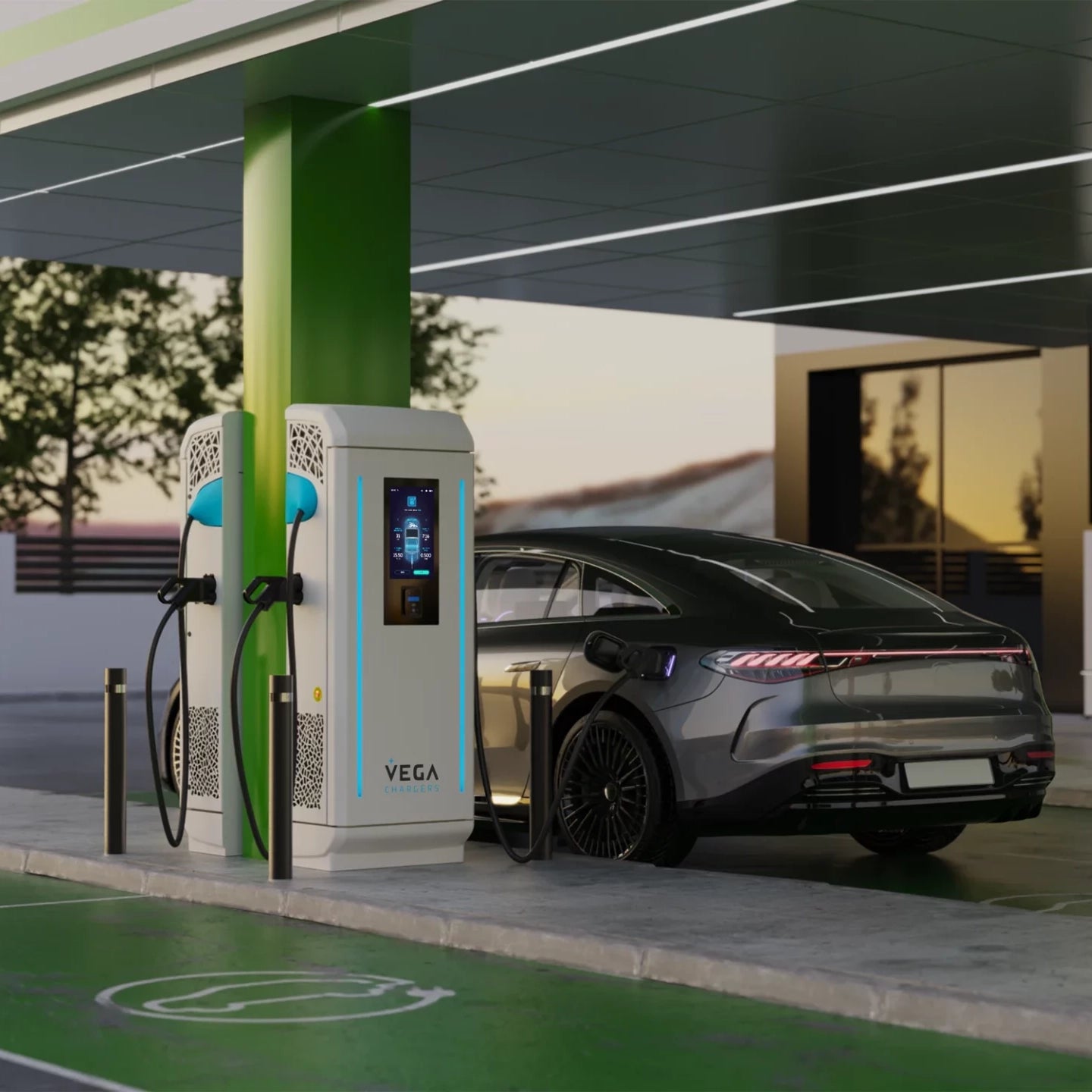
VEGA's ALOHA stations are built in stainless steel with IP55 weather protection and IK10 impact resistance for exposed public sites. Every model supports OCPP 1.6J back-office management, dynamic load management, RFID and ISO 15118 Autocharge, with an optional cashless payment terminal so anyone can tap and charge without an app.

VEGA Chargers
ALOHA Gravity DC 40kW — Compact Wall or Pedestal
The compact entry to DC fast charging, adding up to 267km (about 165 miles) of range per hour. Whisper-quiet at ≤55 dBA, it's ideal for hotels, restaurants, office car parks and taxi operators with limited space.
£11,700 inc. VAT (£9,750 ex. VAT)

VEGA Chargers
ALOHA Lander DC 60kW — Dual CCS2 Simultaneous
Two CCS2 connectors charge two cars at once, splitting power automatically. Side ventilation allows back-to-back installation, doubling bays per metre — a smart choice for supermarkets, retail parks and fleet depots.
£23,500 inc. VAT (£19,583.33 ex. VAT)

VEGA Chargers
ALOHA Lander Plus 120kW — Dual CCS2 + 22kW AC
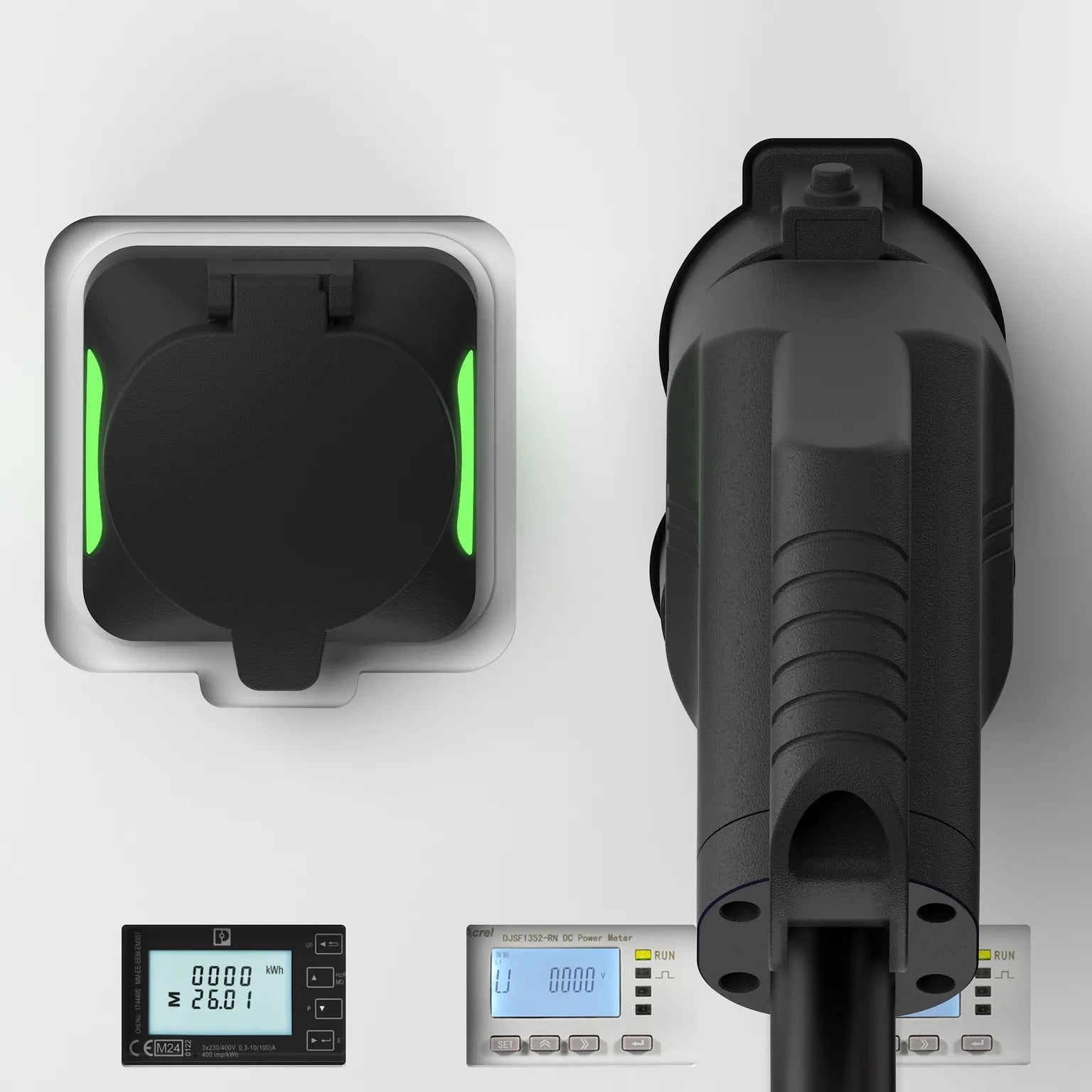
Charges up to three vehicles simultaneously: two DC CCS2 outlets plus an integrated 22kW Type 2 AC socket with a certified meter. Adds around 200km in 15 minutes — the sweet spot for busy retail and mobility hubs.
£41,300 inc. VAT (£34,416.67 ex. VAT)
VEGA Chargers
ALOHA Lander Plus 160kW — Dual CCS2 + 22kW AC
160kW to a single car or 2 × 80kW when both DC ports are in use, with the 22kW AC socket running independently. Adds up to 267km in 15 minutes for high-traffic service stations and fleet operations.
£51,300 inc. VAT (£42,750 ex. VAT)
VEGA Chargers
ALOHA Lander Plus 240kW — Flagship Ultra-Rapid
The flagship: 240kW to one car or 2 × 120kW simultaneously, with 500A boost and a 22kW AC socket. Around 400km of range in 15 minutes — built for motorway service areas, high-volume hubs and major fleet depots.
£59,900 inc. VAT (£49,916.67 ex. VAT)
22kW & 7kW AC Chargers for Small to Mid-Size Businesses
For most small and medium-sized businesses, a bank of AC wallboxes delivers the best value per charging bay. The 22kW three-phase units below suit hotels, leisure sites and depots; the 7kW single-phase units suit offices and premises without a three-phase supply.

Sigenergy
Sigen EVAC 22kW 4G — Type 2 Shutter Socket
Untethered 22kW three-phase charger with built-in 4G, so it stays online even where site Wi-Fi doesn't reach the car park. OCPP 1.6J, RFID, dynamic load management, IP65 and a 10-year warranty.
£770 inc. VAT (£641.67 ex. VAT)

Sigenergy
Sigen EVAC 22kW 4G — 5m Tethered Cable
The same smart 22kW platform with a fixed 5-metre Type 2 cable — guests and customers just plug in, no cable of their own required. Pairs with SigenStor for 100% solar charging modes.
£830 inc. VAT (£691.67 ex. VAT)

SolarEdge
SolarEdge 22kW 3-Phase — Type 2 Socket, RFID & MID
RFID access control plus a MID-certified meter means readings can legally be used for billing — ideal for landlords, shared car parks and employee reimbursement. Solar-optimised charging with a SolarEdge inverter.
£1,350 inc. VAT (£1,125 ex. VAT)

Fox ESS
Fox 7kW L Series — Commercial, 5m Type 2 Cable
The budget-friendly commercial workhorse for single-phase sites: RFID authentication, OCPP 1.6/2.0.1, wired Ethernet and dynamic load balancing. Perfect for staff car parks, surgeries and HMOs.
£395 inc. VAT (£329.17 ex. VAT)

SolarEdge
SolarEdge 7.4kW 1-Phase — 6m Tethered Type 2
A smart single-phase charger with a generous 6-metre cable, designed to soak up surplus solar PV. A strong fit for small businesses and owner-operators already running a SolarEdge system.
£1,030 inc. VAT (£858.33 ex. VAT)
Full Specification Comparison
| Model | Type | Max power | Supply | Connectors | Vehicles at once | Access & comms | Protection |
|---|---|---|---|---|---|---|---|
| VEGA Gravity 40kW | DC | 40kW | 400V 3-ph, 65A | CCS2 (CHAdeMO + CCS2 option) | 1 | OCPP 1.6J, RFID, 4G/Ethernet, Autocharge | IP55 / IK10 |
| VEGA Lander 60kW | DC | 60kW (2 × 30kW) | 400V 3-ph | 2 × CCS2 | 2 | OCPP 1.6J, RFID & 4G standard | IP55 / IK10 |
| VEGA Lander Plus 120kW | DC + AC | 120kW + 22kW AC | 400V 3-ph, 220A | 2 × CCS2 + Type 2 | 3 | OCPP 1.6J, RFID, 4G, 15.6" screen | IP55 / IK10 |
| VEGA Lander Plus 160kW | DC + AC | 160kW + 22kW AC | 400V 3-ph, 281A | 2 × CCS2 + Type 2 | 3 | OCPP 1.6J, RFID, 4G, 15.6" screen | IP55 / IK10 |
| VEGA Lander Plus 240kW | DC + AC | 240kW + 22kW AC | 400V 3-ph, 404A | 2 × CCS2 + Type 2 | 3 | OCPP 1.6J, RFID, 4G, 15.6" screen | IP55 / IK10 |
| Sigen EVAC 22 Socket | AC | 22kW | 400V 3-ph (1-ph capable) | Type 2 shutter socket | 1 | OCPP 1.6J, RFID, 4G/Wi-Fi/Ethernet | IP65 |
| Sigen EVAC 22 Tethered | AC | 22kW | 400V 3-ph (1-ph capable) | 5m Type 2 cable | 1 | OCPP 1.6J, RFID, 4G/Wi-Fi/Ethernet | IP65 |
| SolarEdge 22kW RFID/MID | AC | 22kW (7.4kW on 1-ph) | 400V 3-ph | Type 2 socket | 1 | RFID, MID meter, Wi-Fi/Ethernet, OCPP | IP54 / IK10 |
| Fox 7kW L Series Commercial | AC | 7.3kW | 230V 1-ph, 32A | 5m Type 2 cable | 1 | OCPP 1.6/2.0.1, RFID, LAN/Wi-Fi/Bluetooth | IP55 / IK08 |
| SolarEdge 7.4kW | AC | 7.4kW | 230V 1-ph, 32A | 6m Type 2 cable | 1 | Wi-Fi/Ethernet, OCPP, app | IP54 / IK10 |
Planning Your Installation
Check your supply
Confirm whether you have single- or three-phase and how much spare capacity remains. DC stations from 120kW upwards usually need a DNO application and possibly a supply upgrade.
Map dwell times
Count how long customers, staff and vehicles actually park. That tells you the AC/DC split and how many bays you need.
Choose a back office
Every commercial unit here is OCPP-compatible, so you can pick any charge point management platform for pricing, billing and reporting.
Use a qualified installer
Installation must be carried out by a qualified electrician to BS 7671 and the IET Code of Practice for EV charging. DC units need a concrete base or anchor bolts and forklift placement.
Need mounting posts, cables or protection devices? Browse our EV charging accessories. Running solar PV already? Pairing chargers with a battery storage system lets you charge vehicles on free daytime solar and cheap off-peak grid energy.
Standards & Certifications
Frequently Asked Questions
Is a 22kW charger worth it if most cars only accept 11kW AC?
Usually, yes. The price difference between an 11kW and 22kW unit is small, cars with 22kW onboard chargers get the full benefit, and every other car simply draws what it can accept. You also future-proof the bay as newer vehicles arrive.
Can I install a 22kW charger on a single-phase supply?
You can install it, but it will be limited to about 7.4kW. The Sigenergy EVAC 22 switches automatically between three-phase and single-phase operation, and the SolarEdge 22kW falls back to 7.4kW. If you only have single-phase, the Fox 7kW commercial unit is the more economical choice.
How much electrical capacity does a DC rapid charger need?
It varies by model. The VEGA Gravity 40kW needs a 400V three-phase supply with 65A nominal input current; the Lander Plus 240kW needs 404A with its AC output active. Always confirm capacity with a qualified electrician and your Distribution Network Operator before ordering.
Can customers pay without downloading an app?
Yes. All VEGA ALOHA stations offer an optional contactless payment terminal, so drivers can tap a bank card or phone. They also support RFID cards, PIN codes and ISO 15118 Autocharge.
How do I charge staff or tenants for the electricity they use?
Use an OCPP-compatible charger with RFID so every session is linked to a user. For legally recognised billing — for example a landlord recharging tenants — choose a unit with a MID-certified meter such as the SolarEdge 22kW RFID/MID.
What is dynamic load management and do I need it?
It monitors your building's demand and automatically adjusts charging power so your main supply is never overloaded. It lets you install more charge points without an expensive supply upgrade, and every commercial charger in this guide supports it.
What's the difference between tethered and socket chargers?
A tethered charger has a fixed cable, so drivers simply plug in — best for hotels and customer-facing sites. A socket (untethered) charger requires drivers to use their own Type 2 cable, which keeps the unit tidy and avoids cable damage in busy public car parks.
Planning EV charging for your business?
From a single 7kW point for a village surgery to a multi-bay 240kW hub on a motorway corridor, AIZO Quality Heating supplies the full range with free UK express delivery on most orders. Tell us about your site and we'll put together a tailored quote.