


Whether you're replacing a tired vented cylinder, fitting out an off-grid caravan, or looking for an efficient unvented hot water solution without the faff of a gas boiler, the Quality Heating (QH) range of electric storage water heaters covers every scenario — from 30 litres at 12V DC right through to 120-litre floor-standing mains-pressure units.
This guide walks you through every model in the range, highlights the premium stainless steel WiFi flat heater, and covers everything you need to know before installation.
What Is an Electric Storage Water Heater?
The fundamentals, and why they're increasingly popular across the UK
An electric storage water heater — sometimes called a hot water cylinder or electric water tank — stores a pre-heated volume of water ready for immediate use. Unlike an instantaneous combi system that heats water on demand, a storage unit heats a fixed volume using one or more immersion elements, then keeps it insulated until needed.
The main advantage is consistent mains-pressure hot water at every outlet without the flow rate limitations of a combi boiler. They're well-suited to properties off the gas grid, holiday lets, flats with no flue provision, annexes, and increasingly in solar-integrated homes where excess PV generation is diverted to the immersion to heat water for free.
Vented vs Unvented: A vented cylinder is open to atmosphere via an expansion pipe and relies on a separate cold water storage cistern in the loft. An unvented cylinder connects directly to the mains cold water supply, delivering higher-pressure hot water without needing a header tank. All QH models are mains-pressure, unvented units — the preferred choice for modern installations.
Single vs Dual Element: QH's standard vertical and horizontal models feature dual immersion elements — a lower element to heat the full tank overnight on cheap-rate tariffs, and an upper element to quickly boost the top portion for immediate use. The flat WiFi model uses a dedicated high-efficiency element with smart scheduling.
Editor's Pick
Our most technologically advanced water heater — WiFi, A energy rating, and a genuine stainless steel inner tank
80 Litre QH Flat A-Rated Electric Storage Water Heater — WiFi & Stainless Steel Tank
The flagship of the QH range. Its flat, wall-mounted profile suits airing cupboards and utility rooms where floor space is at a premium. The genuine stainless steel inner tank eliminates corrosion risks associated with vitreous enamel linings, giving significantly extended service life — particularly important in areas with soft or slightly acidic water.
- 80-litre capacity — suitable for 3–4 person households
- A energy efficiency rating — lower running costs
- Stainless steel inner tank — outstanding corrosion resistance
- Built-in WiFi — schedule and monitor via smartphone app
- Flat profile — wall-mounted, space-saving installation
- Compatible with solar immersion controllers (e.g. iBoost, Eddi)
- Factory-fitted safety group: PRV, expansion vessel, check valve
£358.33 exc. VAT | Pay in 3 with Klarna
View Product & Order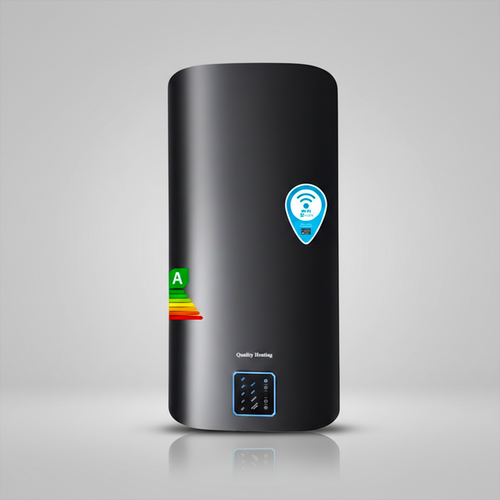
Why Choose a Stainless Steel Inner Tank?
The material choice that matters most when selecting a storage water heater
Corrosion Resistance
Naturally resistant to rust and pitting, even with chlorinated or soft water — far outperforming vitreous enamel linings over time.
No Sacrificial Anode
Enamel tanks need a magnesium anode replaced periodically. Stainless steel tanks don't — reducing maintenance intervals and long-term cost.
Extended Service Life
A quality stainless steel tank can last 20–25 years with minimal maintenance, compared to 10–15 years for a standard enamel-lined cylinder.
Smart WiFi Control
Schedule heating around cheap-rate tariffs (Economy 7, Agile), monitor energy usage, and boost remotely — all from your smartphone.
Solar PV Compatible
Pair with an immersion diverter (myenergi Eddi, Solar iBoost) to route surplus solar generation to heat your water for free.
Space-Saving Flat Profile
The flat, wall-mountable design fits where conventional upright cylinders can't — ideal for apartments, airing cupboards, and tight utility rooms.
Horizontal Floor-Standing Models
Where vertical installation isn't practical — dual-element horizontal units with the same mains-pressure performance. Ideal for under-stair cupboards, plant rooms with low headroom, or loft conversions.
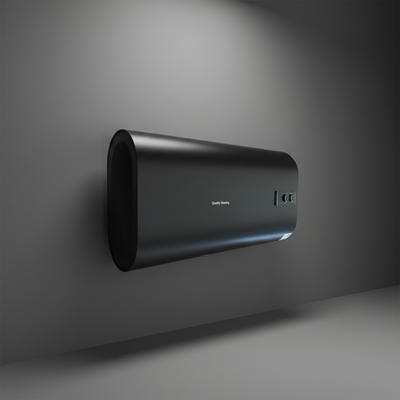
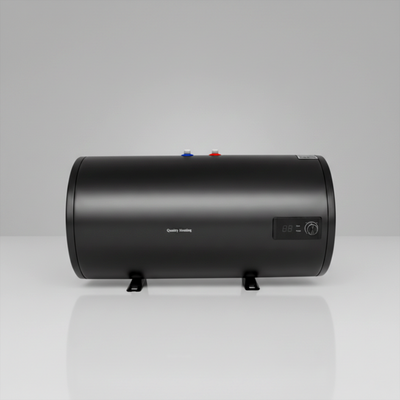
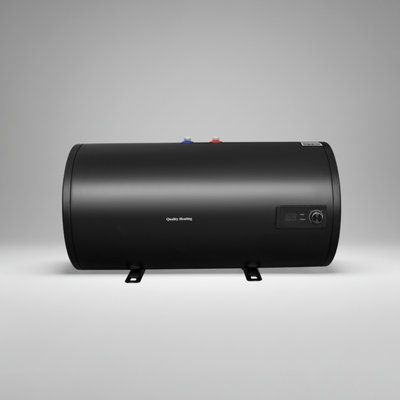
← Swipe to browse all horizontal models
The Full QH Water Heater Range
Seven models covering every application — from compact 50L units to large-capacity 120L cylinders
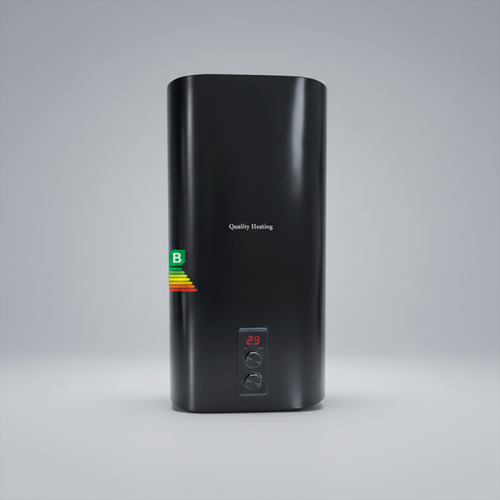
50 Litre QH Dual Electric Water Heater
Compact vertical unit — ideal for 1–2 person households, annexes, or rental properties. Dual-element design for quick-boost or full overnight cycles.
- Capacity50 litres
- ElementsDual immersion
- ControlsDigital thermostat
- OrientationVertical
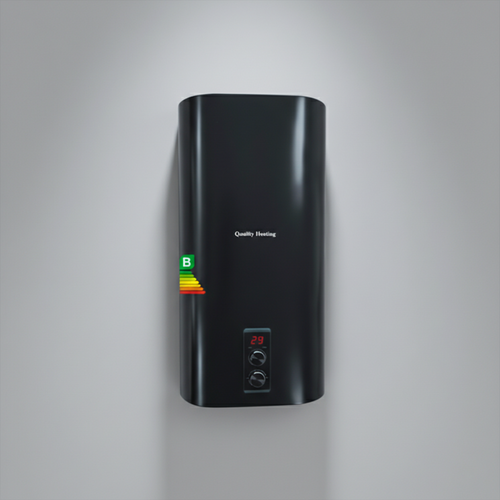
80 Litre QH Dual Electric Storage Water Heater
The workhorse of the range — 80 litres, dual elements, digital controls. Perfect for the average UK household of 2–4 people.
- Capacity80 litres
- ElementsDual immersion
- ControlsDigital thermostat
- OrientationVertical
80L QH Flat A-Rated WiFi — Stainless Steel Tank
Flat profile, WiFi app, A energy rating, and genuine stainless steel inner tank. Premium long-life choice with smart home integration.
- Capacity80 litres
- Tank materialStainless steel
- Energy ratingA-rated
- ConnectivityWiFi + app
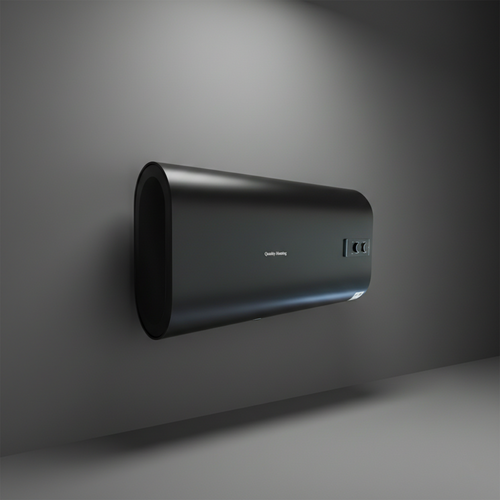
80 Litre QH Dual Horizontal Electric Water Heater
Same dual-element performance as the vertical 80L in a horizontal floor-standing format — fits neatly in low-headroom spaces.
- Capacity80 litres
- ElementsDual immersion
- ControlsDigital thermostat
- OrientationHorizontal
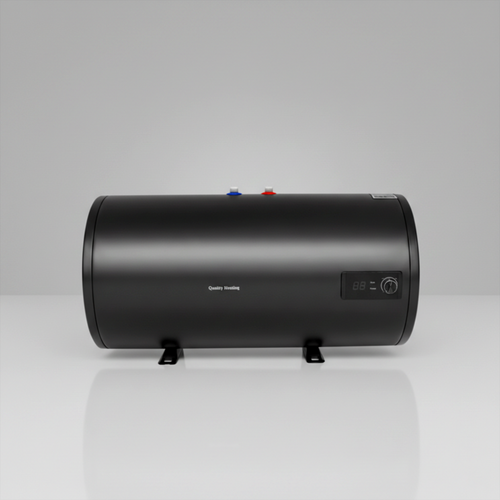
100 Litre QH Dual Horizontal Electric Water Heater
For households of 4–5 people or properties with high simultaneous hot water demand. Programmable digital temperature controls.
- Capacity100 litres
- ElementsDual immersion
- ControlsDigital thermostat
- OrientationHorizontal
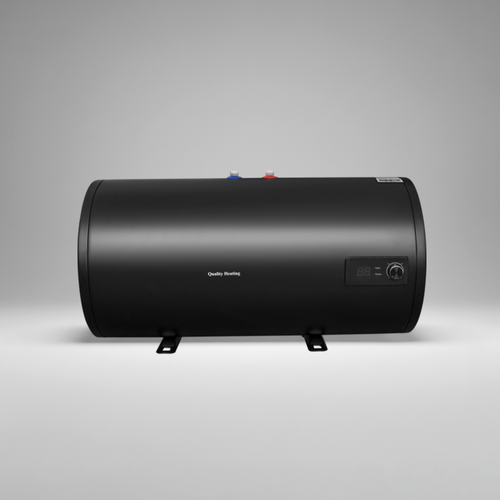
120 Litre QH Dual Horizontal Electric Water Heater
Largest unit in the horizontal range — for busy households of 5+ or holiday lets needing a large hot water reserve on demand.
- Capacity120 litres
- ElementsDual immersion
- ControlsDigital thermostat
- OrientationHorizontal
Off-Grid & Leisure: Caravan Model
12V DC operation — purpose-built for caravans, motorhomes, narrowboats, and off-grid applications
30 Litre QH 12V DC Caravan Horizontal Water Heater
Unlike the rest of the QH range which operate on a 230V mains supply, this 30-litre horizontal unit runs directly from a 12V DC supply — the ideal solution for caravans, motorhomes, narrowboats, and campervans powered by a leisure battery bank or solar panel array.
At 30 litres, it provides ample hot water for washing-up, rinsing, and showering. The horizontal format installs neatly under benches or in vehicle floor-level lockers.
- 12V DC operation — no inverter required
- 30-litre capacity — ideal for 1–2 persons
- Horizontal orientation — fits under-bench or in a locker
- Compact, lightweight construction
- Low-power element — gentle on leisure battery draw
- Compatible with solar panel charging systems
- Thermostatically controlled for energy efficiency
£245.83 exc. VAT | Express UK Delivery Available
View Product & Order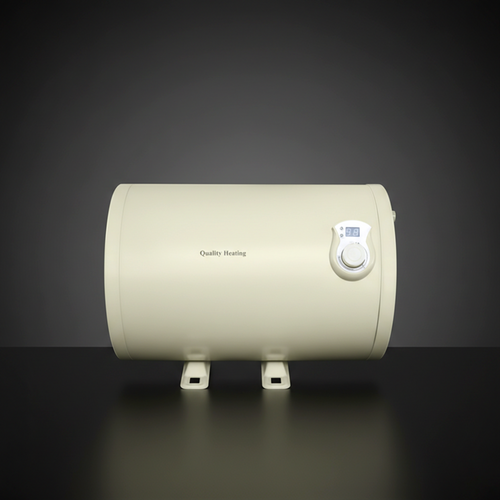
Full Model Comparison
Quick-reference specification table across the entire QH water heater range
| Model | Capacity | Orientation | Supply | Elements | Tank Material | ErP Class | WiFi | Price (inc. VAT) |
|---|---|---|---|---|---|---|---|---|
| QH 50L Dual Vertical | 50L | Vertical | 230V AC | Dual | Enamel-lined | B | — | £295.00 |
| QH 80L Dual Vertical | 80L | Vertical | 230V AC | Dual | Enamel-lined | B | — | £330.00 |
| QH 80L Flat WiFi ⭐ | 80L | Flat / Wall | 230V AC | High-eff. | Stainless Steel | A | ✓ Yes | £430.00 |
| QH 80L Horizontal | 80L | Horizontal | 230V AC | Dual | Enamel-lined | B | — | £350.00 |
| QH 100L Horizontal | 100L | Horizontal | 230V AC | Dual | Enamel-lined | B | — | £470.00 |
| QH 120L Horizontal | 120L | Horizontal | 230V AC | Dual | Enamel-lined | B | — | £490.00 |
| QH 30L 12V Caravan | 30L | Horizontal | 12V DC | Single | Enamel-lined | N/A — 12V DC | — | £295.00 |
ErP Energy Label Ratings Explained
What the energy class on your water heater actually means — and how it differs from a property EPC
Every mains-powered water heater sold in the UK must carry an ErP (Energy Related Products) energy label under the Ecodesign Directive — the same A–G scale used on washing machines and fridges. This rates the product's thermal efficiency: how well it retains heat, how efficiently it heats water, and how little standby energy it wastes.
Important: ErP ratings are for the appliance itself. They are separate from an EPC (Energy Performance Certificate), which rates the energy efficiency of a property as a whole and is calculated on fuel costs, insulation, heating systems, and more. Your water heater's ErP class is one input into an EPC assessment but does not directly equal a property EPC band.
Class A — Premium Efficiency
The highest common rating for electric storage water heaters. Achieved by the QH 80L WiFi Flat through superior insulation, a high-efficiency heating element, and smart scheduling to minimise standby losses. Class A units waste significantly less energy keeping water hot between uses.
✓ QH 80L Flat WiFi (Stainless Steel)
Class B — Good Efficiency
A solid efficiency rating achieved by the remaining QH 230V models. Class B units use high-quality polyurethane foam insulation (typically 35–50mm) and accurate digital thermostats to minimise heat loss. Suitable for all domestic applications and compliant with current UK Ecodesign requirements.
✓ QH 50L Vertical · 80L Vertical · 80L / 100L / 120L Horizontal
💡 What improves your property's EPC hot water score? The SAP methodology used in UK EPC assessments rewards: dual immersion elements (off-peak overnight + peak top-up), a dual-rate electricity meter (Economy 7 / Economy 10), well-insulated cylinders (50mm+ foam), and cylinder thermostats. All 230V QH models tick these boxes. Pairing with a solar PV diverter — such as the myenergi Eddi or Solar iBoost — to use surplus solar generation further improves your effective running cost and EPC hot water contribution.
Installation Guide & Key Considerations
What you need to know before fitting an unvented electric storage water heater in the UK
Qualified Installer Requirement
Unvented hot water cylinders above 15 litres must be installed by a G3-qualified competent person — registered under the APHC or CIPHE unvented hot water scheme. This is a Building Regulations Part G requirement and is non-negotiable for insurance and safety compliance.
Electrical Supply
230V models require a dedicated radial circuit from your consumer unit, appropriately fused (typically 20A). Always use an NICEIC or NAPIT-registered electrician. The 12V DC caravan model connects directly to your leisure battery system.
Cold Mains Supply Pressure
Ideal incoming pressure is 1.5–3 bar dynamic. If your supply exceeds 3.5 bar, a pressure reducing valve (PRV) must be fitted upstream — standard practice included in most unvented installation kits.
Safety Group Components
A correctly installed unvented system must include: PRV, check valve, expansion vessel, temperature and pressure relief valve (TPRV), and a suitable tundish and discharge pipe to drain. Verify whether these are factory-fitted before ordering.
Discharge Pipe Routing
The TPRV discharge pipe must terminate safely to atmosphere via a tundish to an external gully or suitable drain. Pipe sizing and routing must comply with BS 6700 and the manufacturer's installation instructions.
Building Regulations Notification
Installation of an unvented hot water cylinder is notifiable work under Building Regulations Part G. A competent person scheme member can self-certify; otherwise notify your local authority building control (LABC) before work commences.
⚠️ Other Things to Consider Before Installation
- Check incoming mains flow rate (litres/min) to confirm the unit meets peak demand requirements
- Insulate all hot water pipework to current Building Regulations standards to minimise heat losses
- Consider Economy 7 or smart tariff scheduling to reduce running costs significantly
- Plan a tundish discharge outlet close to the unit — this affects permissible siting locations
- Water hardness affects scale build-up on the element — fit a scale inhibitor in hard water areas
- Leave adequate service access clearance for element replacement and annual servicing
- Programme a weekly thermal disinfection cycle at 60°C for Legionella prevention compliance
- For the 12V caravan model, match element wattage to your battery bank capacity to avoid excessive discharge
Choosing the Right QH Model for Your Needs
Matched to the most common UK installation scenarios
1–2 Person Household or Studio Flat
The 50-litre QH Dual Vertical (£295) is the sensible starting point. Compact enough for most airing cupboards, it comfortably supplies hot water for a shower, sink, and washing-up throughout the day.
2–4 Person Household — Standard Scenario
Choose the 80-litre QH Dual Vertical (£330) or the 80-litre Horizontal (£350) depending on available space. For longevity, smart scheduling, and a maintenance-free inner tank, the 80L WiFi Flat with Stainless Steel tank (£430) is well worth the additional outlay.
4–5+ Person Household or Holiday Let
Move up to the 100-litre or 120-litre horizontal units (£470–£490). Well-suited to properties where multiple bathrooms will be used simultaneously or where hot water demand is unpredictable — such as holiday lets or HMOs.
Caravan, Motorhome, Narrowboat, or Off-Grid
Only one answer: the 30-litre QH 12V DC Caravan Horizontal (£295). No inverter needed, low leisure battery draw, and a proven horizontal format that fits the constraints of a vehicle installation.
Solar PV Owners
Any 230V QH model can be integrated with a solar PV diverter such as the myenergi Eddi or Solar iBoost to route surplus generation into the immersion element. The 80L WiFi Flat takes this further with built-in smart scheduling — potentially reducing hot water energy costs to near-zero between April and September.
Ready to Order? We're Here to Help.
Browse the full QH water heater range online, or get in touch with our team for advice on sizing, installation requirements, or solar integration.