


A gas boiler turns every ten units of gas into roughly nine units of heat. A heat pump turns one unit of electricity into three, four or more units of heat by moving warmth out of the outside air. Electricity costs more per kWh than gas, so the real question is whether the heat pump's efficiency is high enough to cover that gap in your home.
The same heat pump can be cheap or expensive to run. Flow temperature, sizing and controls decide which.
This guide explains how to compare running costs for your own tariff, the difference between R290 and R32 heat pumps, the controls that make the biggest difference, and the parts that complete a system.
Are heat pumps cheaper to run than gas boilers?
Short answer: usually yes, when the heat pump is sized from a heat loss calculation, runs at a low flow temperature and reaches a seasonal efficiency (SCOP) higher than the ratio between your electricity and gas unit prices. A poorly designed system running hot can cost more than the boiler it replaced.
A modern condensing gas boiler typically delivers around 85–90% efficiency in real homes. A heat pump's equivalent figure is its SCOP: a SCOP of 4 means four kWh of heat for every kWh of electricity across a whole heating season. Because both fuels are billed per kWh, you can compare them directly once you know your unit rates.
Unit prices change regularly, so we don't quote them here. Use the rates on your own bill, or check the current limits on Ofgem's energy price cap page.
How do you compare heat pump running costs with gas?
Short answer: work out how many kWh of fuel each system needs to deliver the same amount of heat, then multiply by your unit rate. A heat pump needs far fewer kWh; the question is whether its higher price per kWh outweighs that.
Here is the fuel each system needs to deliver 1,000 kWh of heat into your home. Multiply the right-hand column by your unit rate to get the cost.
| Heating system | Efficiency | Fuel needed per 1,000 kWh of heat |
|---|---|---|
| Gas boiler | 90% | 1,111 kWh of gas |
| Gas boiler (older or poorly set up) | 80% | 1,250 kWh of gas |
| Heat pump, high flow temperature | SCOP 3.0 | 333 kWh of electricity |
| Heat pump at 55°C flow (Ecodan 6kW R32) | SCOP 3.56 | 281 kWh of electricity |
| Heat pump at 35°C flow (Ecodan 6kW R32) | SCOP 4.76 | 210 kWh of electricity |
The break-even test
A heat pump costs less per unit of heat than a gas boiler when:
Heat pump SCOP > (electricity price per kWh ÷ gas price per kWh) × boiler efficiencyExample: if electricity costs four times as much per kWh as gas and your boiler runs at 90%, the heat pump needs a SCOP above 3.6 to win on unit costs. Plug in your own rates from your bill or the Ofgem price cap.
Two things often tip the balance further: a heat pump or time-of-use tariff that lowers your electricity rate, and dropping the gas standing charge entirely once the boiler is removed.
What makes a heat pump cheaper or more expensive to run?
Short answer: flow temperature has the biggest effect, followed by correct sizing, good controls and your electricity tariff. The refrigerant matters less than how the system is designed.
Flow temperature
Every degree lower helps. The Ecodan figures above show a SCOP of 4.76 at 35°C dropping to 3.56 at 55°C. Larger radiators or underfloor heating let the system run cooler.
Correct sizing
An oversized unit cycles on and off; an undersized one leans on its backup heater. Size from a room-by-room heat loss calculation, not floor area.
Controls and settings
Weather compensation and steady, long run times keep efficiency high. Turning the heating hard on and off like a boiler wastes the advantage.
Tariff and standing charges
A cheaper overnight or heat pump tariff lowers the break-even SCOP, and going all-electric removes the gas standing charge.
What is the difference between R290 and R32 heat pumps?
Short answer: both are refrigerants that carry heat from outside to your heating system. R290 (propane) has a global warming potential of 3 and can reach higher flow temperatures, which suits homes keeping existing radiators. R32 has a global warming potential of 675, a longer track record, and is the refrigerant most installers already know well.
| R32 | R290 (propane) | |
|---|---|---|
| Global warming potential | 675 | 3 |
| Flammability class | A2L (mildly flammable) | A3 (highly flammable) |
| Typical system types | Monobloc and split | Mostly monobloc, with the refrigerant kept outdoors |
| High flow temperatures | Model dependent | Many models designed for up to 70–75°C |
| Best fit | Well-insulated homes, underfloor heating, upgraded radiators | Retrofits keeping more of the existing radiators |
| Installer training | Widely held across the trade | Brand-specific R290 safety training usually required |
| Siting | Standard clearances | Extra clearance from drains, openings and ignition sources |
On running costs alone, neither refrigerant wins outright. A well-designed R32 system at a low flow temperature can cost less to run than an R290 unit pushed to 70°C. Where R290 earns its keep is in homes that cannot run cool, because it holds its efficiency better at the higher temperatures those homes need.
Why do installers love R32?
Short answer: familiarity. R32 has been used in air conditioning and heat pumps for years, so engineers already have the training, tools and spares, and R32 units come with fewer siting restrictions than R290.
Known territory
Most refrigeration and air conditioning engineers trained on R32 split systems. Commissioning, fault-finding and servicing are routine.
Easier siting
R290 is heavier than air and highly flammable, so manufacturers set exclusion zones around drains, windows and vents. R32 is more forgiving on tight sites.
Less extra training
Manufacturers such as Daikin require installers to complete R290 safety training before they can commission propane units, on top of the training needed for R32.
Proven parts supply
Spares and service know-how for established R32 ranges are easy to find, which keeps call-outs short.
With a monobloc of either type, the refrigerant circuit is sealed at the factory, so the installer only connects water pipes indoors. That narrows the gap: many installers now fit both, choosing R290 where higher flow temperatures or the lowest-GWP option matter.
Which R32 and R290 heat pumps can you buy from AIZO?
Short answer: Mitsubishi Electric, Panasonic and Samsung each offer an R32 and an R290 range, so you can compare like for like within one brand. Below is one pick of each per brand.

Mitsubishi Electric
Ecodan 6kW R32 Monobloc PUZ-WM60VAA
R32A single-phase, factory-sealed monobloc for typical two to three bedroom homes. SCOP 4.76 at 35°C flow, MELCloud Wi-Fi with energy monitoring built in, and a 45 dB(A) sound pressure at 1m.
£3,200 inc. VAT
View Ecodan R32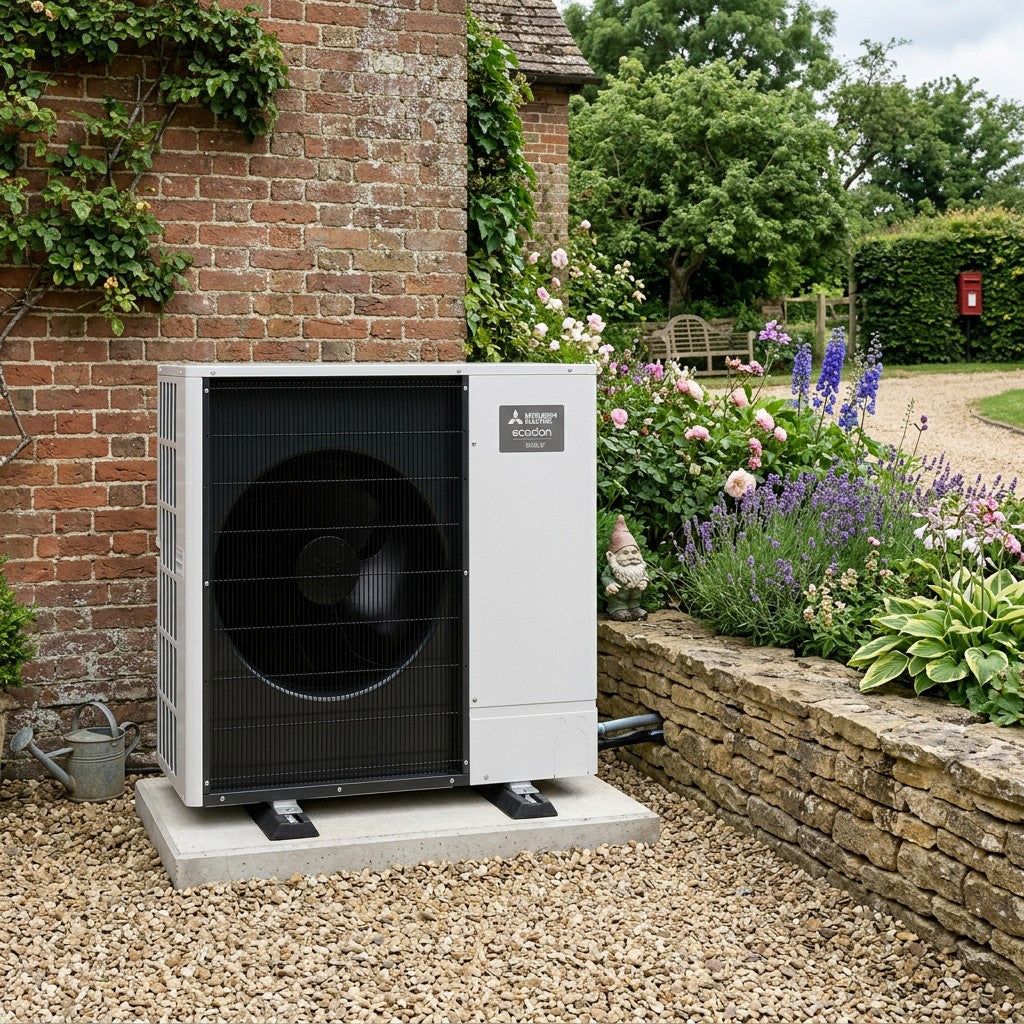
Mitsubishi Electric
Ecodan 8kW R290 Monobloc PUZ-WZ80VAA
R290The Ecodan family on natural propane refrigerant. A single-phase monobloc and a strong choice for retrofits where the lowest-GWP refrigerant and higher flow temperatures matter.
£3,790 inc. VAT
View Ecodan R290
Samsung
EHS HT Quiet Mono R32 (8–14kW)
R32A high-temperature, low-noise R32 monobloc built for radiator-based boiler replacements. Available in single and three-phase versions, with only water connections needed indoors.
From £3,770 inc. VAT
View HT Quiet R32
Samsung
EHS Integrated Mono Gen 7 R290 (5–16kW)
R290Up to 75°C flow for existing radiators, with the pump, expansion vessel and Wi-Fi built into the outdoor unit. SCOP 4.84 at 35°C on the 5kW model.
From £2,995 inc. VAT
View Gen 7 R290
Panasonic
Aquarea J Generation Monobloc R32 (5/7/9kW)
R32A single-phase R32 monobloc with the refrigerant circuit sealed in the outdoor unit. A proven choice for well-insulated homes and underfloor heating.
From £3,100 inc. VAT
View Aquarea J R32
Panasonic
Aquarea L Series R290 Hydro Split (5/7/9kW)
R290Panasonic's propane range in a hydro split layout. The refrigerant stays in the outdoor unit while the indoor module handles the water side.
From £3,100 inc. VAT
View Aquarea L R290| Brand | R32 pick | R290 pick |
|---|---|---|
| Mitsubishi Electric | Ecodan 6kW R32 Monobloc | Ecodan 8kW R290 Monobloc |
| Panasonic | Aquarea J Generation Monobloc R32 (5/7/9kW) | Aquarea L Series R290 Hydro Split (5/7/9kW) |
| Samsung | EHS HT Quiet Mono R32 (8–14kW) | EHS Integrated Mono Gen 7 R290 (5–16kW) |
Prefer a brand that has committed to one refrigerant? R290 ranges include the Ideal Heating HP290, Glow-worm GeniaAir R290 and Stiebel Eltron HPA-O Trend. On R32, see the Hitachi Yutaki M and Daikin Altherma R32 packages. Browse everything in our heat pump collection.
Which heat pump controls lower running costs?
Short answer: weather compensation does the most, because it lowers the flow temperature whenever it's milder outside. Room sensors, sensible scheduling and zoning then stop the heat pump working harder than it needs to.
Weather compensation
An outdoor sensor tells the heat pump how cold it is, and it sets the lowest flow temperature that will still heat the house. This is usually the single biggest running-cost lever.
Room sensors and thermostats
A wireless room sensor fine-tunes output to the actual room temperature, trimming the flow temperature further instead of simply switching the system off and on.
Smart apps and monitoring
App control, such as Mitsubishi's MELCloud, shows how much electricity the system uses, so you can spot settings that cost money and shift hot water to cheaper tariff hours.
Zoning and hot water timing
Separate zones keep unused rooms cooler, and heating the cylinder at set times avoids the heat pump switching to hot water when it should be heating the house.
Heat pumps prefer long, steady run times at a modest temperature. A control that tries to make one behave like a boiler, with big setbacks and fast reheats, usually pushes the flow temperature up and the SCOP down.
Shop heat pump thermostats and controllersHow do you put together a complete heat pump system?
Short answer: start with the heat pump sized to your heat loss, then match a heat pump cylinder, controls and the hydraulic parts the unit needs. Our Heat Pump Kit builder walks you through those choices in one place.
Build your system with the Heat Pump Kit
The Heat Pump Kit matches the right outdoor unit with a compatible cylinder and supporting components, then adds the whole system to your basket. It's the quickest way to avoid ordering a unit without the parts it needs to run.
Open the Heat Pump Kit- Choose your heat pump and output
- Match a heat pump cylinder for hot water
- Add controls, a buffer tank if needed, and fittings
- Add the complete kit to your basket
Do you need a buffer tank, pipe insulation and other components?
Short answer: you always need the hydraulic components and insulated pipework the manufacturer specifies. A buffer tank depends on the system: it's needed where the heating circuit holds too little water for the heat pump to run steadily or defrost properly.
Heat pump components
Most outdoor units are sold on their own. A typical monobloc install also needs anti-freeze valves on the flow and return, a magnetic filter on the return, insulated flexible hoses, isolation valves and a wall bracket or floor stand. Missing any of these can delay commissioning or shorten the life of the system. Find them in our heat pump components range.
Pipe insulation
Pipework between a monobloc and the house carries heated water through cold air, so every uninsulated metre loses heat you've paid for. Use weather and UV-resistant insulation outdoors, and insulate primary pipework inside as well. See our heat pump pipe insulation.
Buffer tanks
A buffer tank adds water volume to the heating circuit. That prevents short cycling, gives the heat pump heat to draw on during defrost, and lets you separate the heat pump's flow rate from heating zones that open and close. Some cylinders, such as the Telford Tempest 200L with integrated 50L buffer, build one in. Browse heat pump buffer tanks.
Heat pump running costs: frequently asked questions
Is a heat pump cheaper to run than a gas boiler?
Usually, if it's correctly sized, runs at a low flow temperature and achieves a SCOP higher than the ratio between your electricity and gas unit prices multiplied by your boiler's efficiency. A badly designed system running hot can cost more than gas.
What SCOP does a heat pump need to beat gas?
Divide your electricity price per kWh by your gas price per kWh, then multiply by your boiler efficiency (around 0.9 for a modern condensing boiler). If the heat pump's SCOP is higher than that figure, it costs less per unit of heat. Current unit rates are on your bill or Ofgem's energy price cap page.
Is an R290 or R32 heat pump cheaper to run?
Neither wins outright. Running cost depends far more on flow temperature, sizing and controls. R290 holds its efficiency better at high flow temperatures, so it can be the cheaper choice in homes keeping their existing radiators.
Do heat pumps cost more to run in winter?
Yes. Efficiency falls as outdoor temperatures drop and the heat pump defrosts more often. That's why SCOP, which averages performance across a whole heating season, is a better guide to annual costs than a single rated COP.
Can I keep my existing radiators with a heat pump?
Often, but radiators sized for an 80°C gas boiler may need upsizing so the heat pump can run at a lower flow temperature. A room-by-room heat loss survey shows which rooms need larger emitters.
Will smart controls reduce my heat pump running costs?
Weather compensation reduces costs most, because it keeps the flow temperature as low as possible. Room sensors, app monitoring, zoning and timing hot water to cheaper tariff hours add further savings.
Do I need a buffer tank with a heat pump?
Not always. A buffer tank is needed where the heating circuit holds too little water for steady running and defrost, or where zone valves can close off most of the system. Your installer's design and the manufacturer's minimum system volume decide it.
Are there grants for replacing a gas boiler with a heat pump?
In England and Wales, the Boiler Upgrade Scheme offers a grant towards an air source heat pump fitted by an MCS-certified installer. Check the current amount and eligibility on GOV.UK. In Scotland, see Home Energy Scotland.
Ready to compare running costs on a real system?
Build a matched heat pump kit, or send us your heat loss figures for a free quote.
Build your heat pump kit Get a free quote