


If you live in the South East, East Anglia, the Midlands, or Yorkshire, there is a very good chance your water is working against your home — and you may not know it. Hard water silently furs up your boiler's heat exchanger, reduces your heat pump's coefficient of performance, scales up your immersion heater elements, and leaves your shower screens streaked white. The solution is straightforward: a properly sized, correctly specified domestic water softener installed on the rising main, protecting everything downstream from the moment it is commissioned.
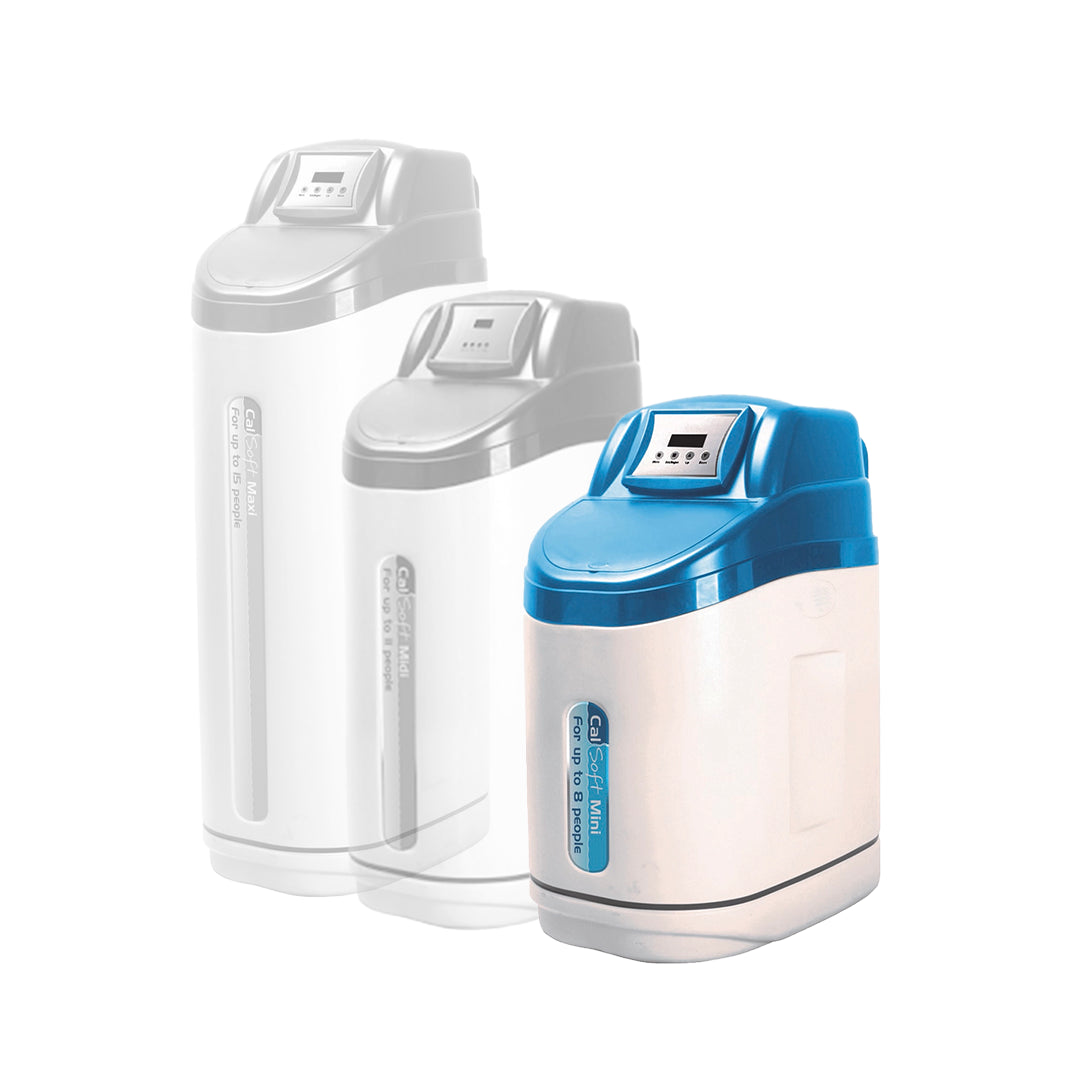
This guide explains how ion exchange water softeners work, where they matter most in a modern UK home, and takes a detailed look at the Calmag CalSoft range — the Mini and Midi — including how to choose between them, which installation kit to order, and how to add a drinking water solution when you soften your supply.
What Is Hard Water — and Why Does It Matter?
Water hardness is a measure of dissolved calcium and magnesium carbonates, expressed in milligrams per litre (mg/l) or parts per million (ppm). As rainwater percolates through chalk and limestone — the bedrock across much of southern and central England — it picks up these minerals and carries them into the mains supply. The water itself is perfectly safe to drink, but the mineral content causes significant problems once it enters your plumbing and heating system.
Is Your Area Affected?
Water is generally classified as hard above 200mg/l and very hard above 300mg/l. The worst-affected regions in the UK include London and the Home Counties, the Thames Valley, East Anglia, Lincolnshire, the East Midlands, and large parts of Yorkshire and the North East. Many properties in these areas see readings of 300–400mg/l — well into the "very hard" category. If your kettle scales up rapidly, your taps have white crusting around the spout, and soap barely lathers, you almost certainly have hard water. Check your postcode on your water supplier's website, or contact our team and we can advise for your area.
The consequences accumulate over months and years rather than appearing overnight. Limescale deposits form wherever water is heated — inside boiler heat exchangers, on immersion heating elements, inside unvented cylinder coils, and throughout the pipework connecting your system. As the scale layer thickens, thermal efficiency drops, flow rates reduce, and components eventually fail early. Beyond the heating system, every appliance that uses hot water — washing machines, dishwashers, coffee machines, electric showers, boiling water taps — is affected in exactly the same way.
How a Water Softener Works: Ion Exchange Explained
All domestic water softeners sold for UK residential use operate on the same fundamental principle: ion exchange. The process is elegantly simple, remarkably effective, and has been in widespread use since the mid-twentieth century.
Hard Water Enters
Mains water — carrying dissolved calcium (Ca²⁺) and magnesium (Mg²⁺) ions — flows in through the inlet connection and enters the resin tank.
Ion Exchange at the Resin Bed
The resin beads are pre-loaded with sodium ions. As hard water passes through, calcium and magnesium ions are attracted to and held by the resin — while sodium ions are released into the water in exchange.
Soft Water Out
Water leaving the resin tank contains sodium instead of calcium and magnesium. This water will not deposit limescale anywhere in your system, and lathers readily with soap.
Automatic Regeneration
When the resin becomes saturated with calcium and magnesium, the softener automatically regenerates using a brine solution (dissolved salt). The calcium and magnesium are flushed to drain, and the resin is recharged with sodium, ready for the next cycle.
The CalSoft range uses metered demand regeneration — meaning the softener monitors actual water consumption via an integrated flow meter and only regenerates when the resin capacity has been genuinely used. This is significantly more efficient than timed regeneration (which regenerates on a fixed schedule regardless of usage) and ensures the softener uses the minimum necessary amount of salt and water per cycle.
Six Reasons Every Hard Water Home Needs a Water Softener
- Boiler and cylinder protection: Limescale on a heat exchanger acts as insulation. A 1mm layer reduces heat transfer efficiency by around 7% — more scale means higher energy bills and eventual premature failure. Softened water eliminates this risk entirely.
- Heat pump efficiency: Air source heat pumps rely on efficient heat exchange between the refrigerant circuit and the domestic heating/hot water circuit. Scale accumulation on heat pump coils and the cylinder coil reduces the COP, directly increasing running costs.
- Appliance longevity: Washing machines, dishwashers, and kettles last significantly longer in softened water. Heating elements — the most scale-vulnerable part of any appliance — are protected from the point of installation.
- Less soap and detergent: Soft water lathers far more readily than hard water. Most households reduce soap, shampoo, and detergent consumption by 50–70% after installing a softener — a real ongoing saving that offsets running costs.
- Cleaner surfaces: Shower screens, taps, tiles, and basins stay free from white deposits. Cleaning time drops significantly and chrome and glass surfaces retain their appearance indefinitely.
- Skin and hair: Hard water reacts with soap to form an insoluble curd that remains on skin and in fabric. Softened water rinses completely clean. Many people with eczema, sensitive skin, or dry hair notice a meaningful improvement after switching.
Water Softeners in Modern UK Heating Systems
A water softener fits into virtually every type of UK domestic system — but the application and the urgency of protection varies by system type. Here is how limescale affects each of the major system configurations, and why softening matters most in certain contexts.
Combi Boilers
Combi boilers heat mains water on demand through a plate heat exchanger — a compact unit with high surface area that is exceptionally vulnerable to scale. Even moderate hardness causes rapid scale accumulation inside the heat exchanger, reducing hot water output and increasing gas consumption. A failed heat exchanger is one of the most common and costly combi boiler repairs.
For combi boiler systems, you need a hi-flow softener (50+ l/min) to match the flow capacity of the 22mm mains connection. The CalSoft Mini, supplied with its 22mm kit, is ideal.
✅ Recommended: CalSoft Mini c/w 22mm Hi-Flow Kit
Air Source Heat Pumps
Air source heat pumps rely on efficient heat transfer between the refrigerant circuit and the heating/hot water circuit via the cylinder coil. Limescale on the coil surface reduces this efficiency — every degree of temperature increase required to compensate costs energy. For heat pump installations, the hot water cylinder should always be on softened water in hard water areas.
Heat pumps also operate at lower flow temperatures than boilers, meaning the system runs longer to reach set point — giving more opportunity for scale deposition in pipework and coils over time.
✅ Recommended: CalSoft Mini (up to 8 people) or CalSoft Midi (up to 11)
Unvented Hot Water Cylinders
Unvented cylinders (Megaflow and equivalents) store pressurised mains-temperature water and heat it via an immersion element or coil. Immersion elements in hard water areas scale rapidly — and a scaled element is both inefficient and prone to early failure. The safety components (pressure relief valve, temperature relief valve, expansion vessel) also need clean water to function reliably over their service life.
Unvented systems use 22mm mains-pressure connections, so a hi-flow softener is required to avoid restricting the peak flow that makes these systems desirable.
✅ Recommended: CalSoft Mini or CalSoft Midi with 19mm Hi-Flow Hoses
Conventional (Gravity-Fed) Systems
Older properties with a vented hot water cylinder, header tank, and indirect coil heating are less sensitive to flow rate restrictions — gravity-fed systems typically deliver 15–25 l/min from the tank. However, the immersion element, the cylinder coil, and all pipework connections still accumulate scale in proportion to water hardness and system age.
For conventional systems with 15mm pipework, the standard 15mm installation kit is appropriate and sufficient. The CalSoft Midi (unit only) paired with a 15mm install kit suits most larger conventional homes.
✅ Recommended: CalSoft Midi + 15mm Install Kit for gravity-fed systems
Solar Thermal & Immersion Systems
Solar thermal systems heat the cylinder coil to high temperatures during peak generation, which accelerates limescale deposition significantly. Similarly, solar-divert immersion controllers that dump excess solar generation into an immersion element cycle it on and off frequently — heating and cooling cycles that promote scale adhesion. Both applications benefit strongly from softened water.
✅ Recommended: CalSoft Mini (hi-flow for mains-pressure solar thermal systems)
Washing Machines, Dishwashers & Showers
Appliance heating elements fail sooner in hard water areas — this is a well-documented relationship. A water softener protecting the whole house supply extends the service life of every water-using appliance, reduces the amount of cleaning product needed, and produces visibly cleaner results. Electric showers, in particular, have small flow heaters that scale rapidly and benefit enormously from soft water.
✅ Any CalSoft model protects all household appliances
The Calmag CalSoft Range: Mini vs Midi
Calmag is a British water treatment specialist with a long track record in domestic and commercial softener design. The CalSoft range is engineered specifically for UK water conditions and UK plumbing conventions — with BSP-standard connections, Part G Building Regulations compliance, and a quick-connect bypass valve with integrated flow meter that simplifies installation and ongoing maintenance. Both models share a 5-year parts warranty.
💡 The Quick-Connect Bypass Advantage
The CalSoft bypass valve incorporates an internal flow meter — saving the 5 inches of installation space typically occupied by a traditional inline meter. The bypass also allows the softener to be isolated for salt refilling or maintenance without interrupting the supply to the rest of the property. This integrated design means fewer joints, less pipework, and a neater installation overall.
| Feature | CalSoft Mini | CalSoft Midi |
|---|---|---|
| SKU | CALSOFTMINI | CALSOFT-MIDI |
| Resin Volume | 12.5 litres | 18 litres |
| Household Size | 1–8 people | 1–11 people |
| Capacity at 300ppm | 2,000 litres | ~2,880 litres |
| Max Flow Rate | 70 l/min (with 22mm kit) | 70 l/min (with 19mm hi-flow hoses) |
| Connections | ¾" & 1" BSP | ¾" & 1" BSP |
| Regeneration Type | Metered demand | Metered demand |
| Salt Compatibility | Block & tablet | Block & tablet |
| Quick-Connect Bypass | ✓ Included | ✓ Included |
| Install Kit Included | ✓ 22mm Hi-Flow Kit | ✗ Unit only — order kit separately |
| Part G Compliant | ✓ Yes | ✓ Yes |
| Warranty | 5-year parts | 5-year parts |
| Best For | Combi boilers, unvented cylinders, heat pumps — up to 8 people | Larger households — any system type, up to 11 people |
Which CalSoft Model Do You Need?
The key decision is resin volume (which determines how long between regeneration cycles) rather than flow rate — both models deliver 70 l/min with the appropriate installation hoses, which is well above the peak demand of any domestic system. Choose between them based on household size:
CalSoft Mini — 1 to 8 People
The go-to choice for the majority of UK homes. Supplied complete with a 22mm hi-flow installation kit, making it ready to connect directly to combi boiler, unvented cylinder, or heat pump pipework. The 12.5L resin and 2,000L capacity at 300ppm provides comfortable headroom for a typical household without excessive regeneration frequency. This is the easiest softener to specify and order — everything needed is in the box.
CalSoft Midi — 1 to 11 People
The higher-capacity unit for larger households or for installers who prefer to supply their own hose kit from existing stock. With 18L of resin, the Midi regenerates less frequently than the Mini under equivalent usage, which means lower salt consumption per day for the same hardness level. Supplied as a unit only — pair with the Calmag 15mm Install Kit for conventional gravity-fed systems, or the 19mm Hi-Flow Hoses for combi/unvented/22mm installations.
Shop the Calmag CalSoft Range
Calmag
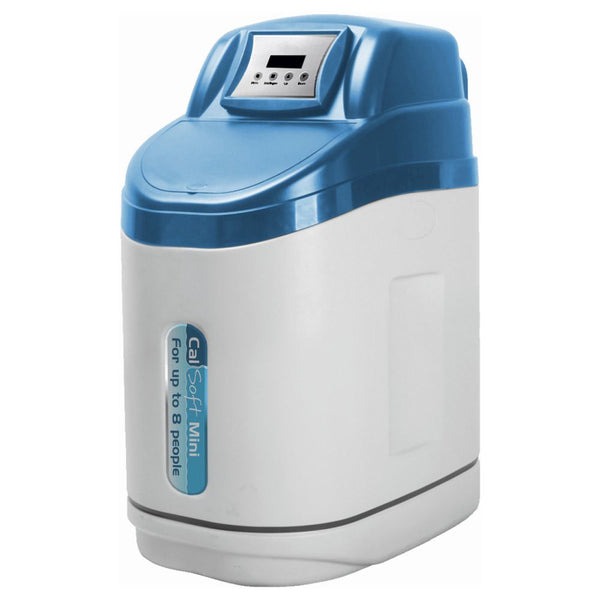
CalSoft Mini c/w 22mm Hi-Flow Kit
The flagship domestic softener from Calmag's CalSoft range. Supplied complete with the 22mm hi-flow installation kit (70 l/min), making it ready out of the box for combi boilers, unvented cylinders, and heat pump systems. The integrated quick-connect bypass with built-in flow meter saves installation space and simplifies servicing. 12.5L resin, 2,000L capacity at 300ppm — suitable for 1 to 8 people. 5-year parts warranty.
Calmag
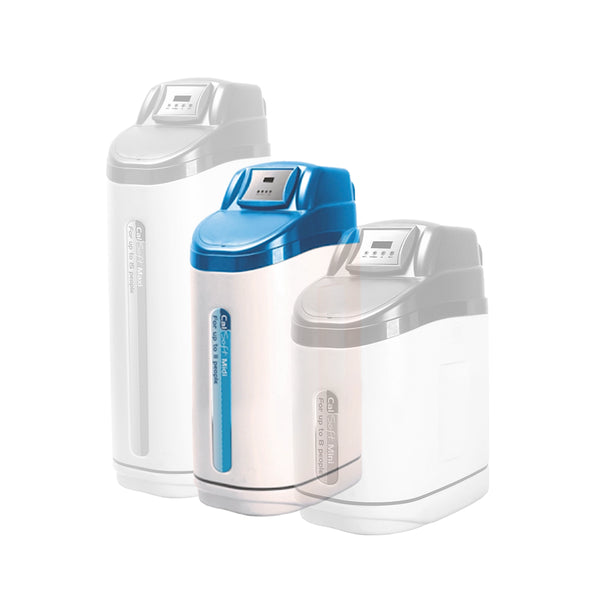
CalSoft Midi — Unit Only
The high-capacity CalSoft model for larger households of up to 11 people, or for installers supplying their own installation hose kit. 18L resin provides greater capacity between regeneration cycles, meaning lower salt consumption over time at equivalent household sizes. Supplied as unit only — order with the Calmag 15mm Install Kit for conventional systems, or the 19mm Hi-Flow Hoses (Pair) for combi/unvented/22mm systems. Quick-connect bypass with integrated meter included. 5-year parts warranty.
Calmag
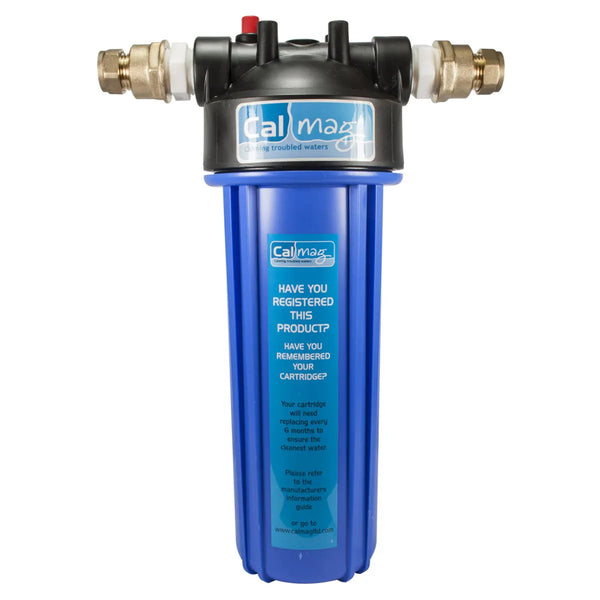
CalFresh C Drinking Water Filter Kit
Softened water is not recommended for drinking, infant formula preparation, or use in sodium-restricted diets — the ion exchange process adds sodium to the water. The CalFresh C provides a complete under-sink drinking water solution for the kitchen cold tap, filtering chlorine, taste, odour, sediment, bacteria, cysts, and heavy metals through a 10" carbon block cartridge. Includes filter housing, cartridge, dedicated drinking tap, and all fittings. No power required. Lifetime housing guarantee on registration. Cartridge replacement every 4–6 months.
Calmag
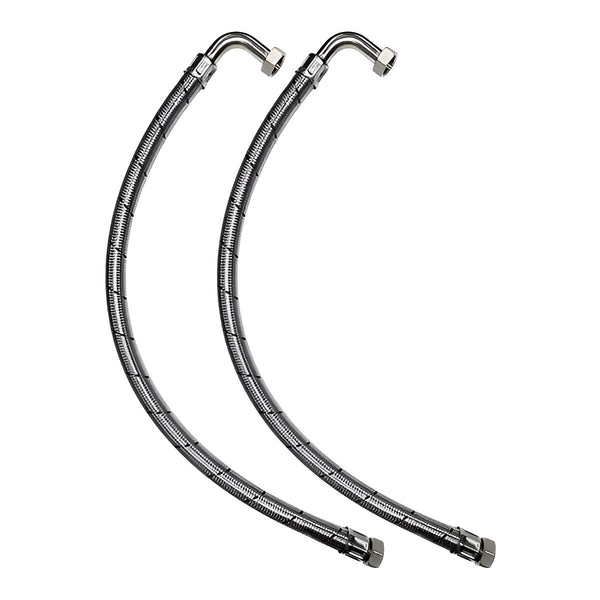
19mm Hi-Flow Hoses (Pair)
The correct installation hose pair for connecting CalSoft Mini or CalSoft Midi softeners to combi boilers, unvented cylinders, Megaflow systems, or any 22mm high-pressure mains installation. Rated to 70 l/min — matching the full flow capacity of the CalSoft bypass valve. Sold as a pair (inlet and outlet). Order when purchasing the CalSoft Midi as a unit-only for a hi-flow system, or as a spare/replacement for any existing CalSoft installation on 22mm pipework.
Installation Accessories & Consumables
Choosing the right installation accessories for your CalSoft softener is as important as choosing the softener itself. The wrong hose diameter can restrict flow and undermine the performance of a high-pressure system. Use the table below to confirm what to order alongside your softener.
| Product | Use Case | Max Flow | Price (Inc. VAT) | Link |
|---|---|---|---|---|
| Calmag 15mm Install Kit | Conventional gravity-fed systems, 15mm pipework, combi boilers with 15mm connections | 50 l/min | £89.00 | View → |
| Calmag 19mm Hi-Flow Hoses (Pair) | Combi boilers, unvented cylinders, Megaflow, 22mm systems — any hi-flow installation | 70 l/min | £70.00 | View → |
| CalFresh C Drinking Water Filter Kit | Under-sink drinking water filtration — essential complement to any whole-house softener | — | £110.00 | View → |
| Fresh C Replacement Cartridge | CalFresh C cartridge replacement — every 4–6 months | — | £47.00 | View → |
Installation: What You Need to Know
Water softener installation in the UK must be carried out in accordance with Part G of the Building Regulations and the Water Supply (Water Fittings) Regulations 1999. Both the CalSoft Mini and Midi are Part G compliant — they incorporate an unbypassable non-return valve to prevent salt contamination of the mains supply in the event of backflow. For most homeowners, installation is best carried out by a qualified plumber familiar with water softener commissioning. Calmag also offers an optional commissioning service — contact us for details.
Key Installation Requirements
Position on the Rising Main
Install after the main stop tap and after any branch to an unsoftened drinking water tap (typically the kitchen cold tap). This is a Building Regulations requirement and ensures a dedicated drinking water point is always available.
Salt Storage Access
Both CalSoft models use block salt (two 4kg blocks) or tablet salt. The unit must be positioned with clear access for the installer or homeowner to lift the lid and add salt when the indicator shows low. A frost-free, indoor location is required — typically under the stairs, in a utility room, or in a kitchen cabinet.
Drain Connection
The softener discharges a brine solution to drain during each regeneration cycle. A nearby drain or standpipe with an air gap is required — the discharge pipe must not be directly connected to the drain to avoid backflow risk.
Power Supply
The CalSoft control valve requires a standard 240V socket within cable reach of the unit. Most utility room and kitchen installations have a socket available. An unswitched fused spur is the ideal permanent solution.
Frequently Asked Questions
Can I drink softened water from the CalSoft?
Softened water is safe for most healthy adults but is not recommended as a primary drinking water source for infants, for preparing baby formula, or for individuals on sodium-restricted diets. The ion exchange process replaces calcium and magnesium with a small amount of sodium. Best practice — and a Building Regulations requirement in most new installations — is to maintain an unsoftened supply to at least one kitchen cold tap. For improved taste and purity at the drinking water tap, pair your CalSoft with the CalFresh C under-sink filter.
Will a water softener reduce my water pressure?
A correctly specified CalSoft softener will not perceptibly reduce flow or pressure. Both CalSoft models deliver 70 l/min with the appropriate hi-flow hoses — well above the peak demand of any domestic system, including combi boilers and unvented cylinders. The key is to match the installation hose diameter to your system: use the 19mm hi-flow hoses for 22mm connections; the 15mm kit for conventional gravity-fed systems.
What is the difference between a water softener and a scale inhibitor?
A water softener uses ion exchange to physically remove calcium and magnesium ions from the water — downstream water is genuinely soft, will not deposit limescale anywhere in the system, and lathers readily with soap. A scale inhibitor (such as an electrolytic or chemical dosing type) modifies the behaviour of calcium carbonate particles to reduce their tendency to adhere to surfaces — it does not remove hardness ions. Inhibitors are appropriate for protecting boiler components as part of a central heating scale inhibitor treatment; a water softener is the whole-house solution.
How much does it cost to run a CalSoft softener?
The primary ongoing cost is salt — block or tablet salt is widely available and the typical annual consumption for a family home in a moderately hard water area is in the region of £50–100 per year. The control valve draws minimal power. Servicing is generally recommended every 3–5 years depending on water quality and usage — the CalSoft's 5-year parts warranty covers the control valve and bypass components against manufacturing defects.
Can I install a CalSoft softener on a heat pump system?
Yes — and it is strongly recommended in hard water areas. The CalSoft Mini (for most households) or CalSoft Midi (for larger homes) should be installed on the rising main in the usual position, protecting the hot water cylinder coil and all downstream pipework. Air source heat pump installations in hard water areas particularly benefit from softened water, as scale on the cylinder coil directly reduces the effective coefficient of performance and increases running costs.
Do I need the CalSoft Mini or Midi?
For most UK homes up to 8 people — choose the CalSoft Mini. It comes supplied with the 22mm hi-flow kit and is the simplest to specify and install. For larger households of up to 11 people, or where a longer interval between regeneration cycles is preferred, choose the CalSoft Midi (unit only) and add the appropriate installation hose kit for your system type. If you are unsure, contact us with your system type and household size and we will confirm the correct specification.
Ready to Protect Your Home from Limescale?
Browse the full CalSoft range and installation accessories — or speak to our team for a tailored softener recommendation based on your system and postcode area.
Related Products & Guides
Air Source Heat Pumps
Explore the full range of air source heat pumps — and protect your investment with softened water in hard water areas.
Unvented Hot Water Cylinders
Megaflow-compatible cylinders for mains-pressure hot water — best paired with a hi-flow water softener in hard water regions.
Scale Inhibitors & Water Treatment
Central heating inhibitors, magnetic scale reducers, and dosing pots for protecting your heating circuit.
Heat Pump Buying Guide
Our comprehensive guide to choosing, sizing, and specifying an air source heat pump for your home.