


The Aquabion S15 & S20: Intelligent Hard Water Protection for UK Homes and Professionals
Hard water is one of the most quietly destructive forces acting on a UK heating system. Approximately 60% of homes in England and Wales sit in areas classified as hard or very hard — meaning every litre of water that passes through your boiler, taps, shower head, and cylinder is laden with dissolved calcium carbonate just waiting to crystallise on every heated surface it touches.
The costs accumulate invisibly. A 1.5 mm coating of limescale on a boiler heat exchanger increases energy consumption by over 10%. Shower heads block within months. Immersion heaters burn out prematurely. Unvented cylinders lose output capacity as scale reduces effective volume. Washing machines and dishwashers work harder and fail sooner. For heating engineers and landlords, the consequences are a recurring cycle of call-outs, parts, descaling chemicals, and premature replacements.
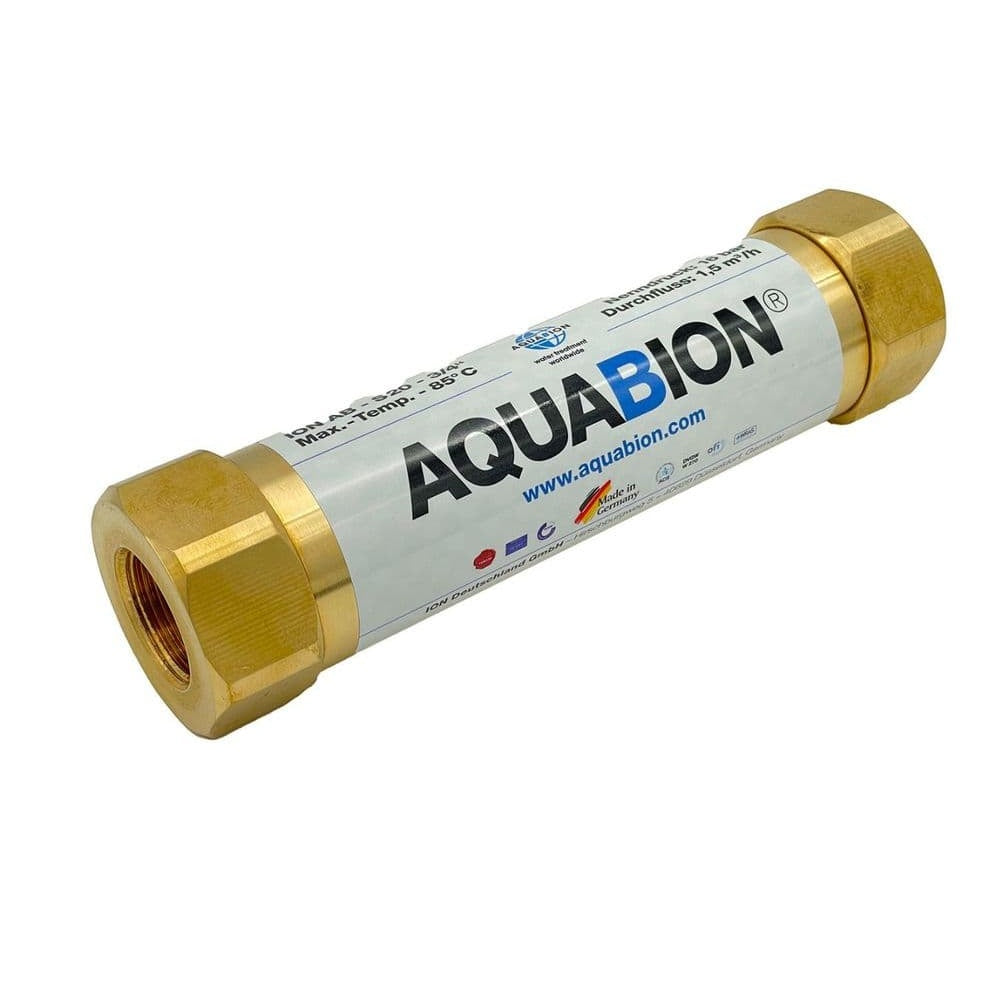
The Aquabion S-Series — and in particular the S15 and S20 models designed for domestic mains supplies — addresses this problem at source, before the water reaches any appliance. Using a patented electrolytic galvanic process, it converts hard-scaling calcite into harmless, non-adherent aragonite crystals — with no salt, no chemicals, no electricity, and no maintenance for its entire seven-year service life.
This guide provides a comprehensive technical and practical overview of the Aquabion S15 and S20 — how the galvanic process works at a molecular level, how to size and install correctly, how it compares to salt-based softeners, and what both homeowners and trade professionals need to know before specifying one.
The Science: How Aquabion's Galvanic Technology Works
To appreciate why Aquabion works — and why it is fundamentally different from magnetic conditioners or inline polyphosphate filters — it helps to understand what limescale actually is at a chemical level.
Hard water contains calcium carbonate (CaCO₃) dissolved in ionic form: Ca²⁺ and CO₃²⁻ ions freely carried in the water column. When this water is heated, or when pressure drops, the dissolved gas (CO₂) that keeps the calcium in solution is released. With CO₂ gone, the calcium and carbonate ions combine and precipitate out of solution — crystallising onto the nearest available surface. That surface is almost always the hottest point in the system: the heat exchanger of your boiler, the element of your immersion heater, or the inner wall of your cylinder.
The crystal form in which calcium carbonate precipitates is calcite — a dense, interlocking crystal lattice with strong adhesion to metal surfaces. Calcite is what makes boiler scale so hard to remove. It essentially becomes part of the metal surface it grows on.
The Aragonite Solution
Aquabion works by introducing a precisely calibrated electrochemical intervention into this process. The unit's zinc sacrificial anodes release zinc ions (Zn²⁺) into the passing water. These zinc ions act as crystallisation seeds that shift the polymorph of calcium carbonate from calcite to aragonite.
Aragonite and calcite are chemically identical — both are CaCO₃. What differs is their crystal structure. Calcite forms a rhombohedral lattice with strong surface adhesion. Aragonite forms an orthorhombic lattice that is physically incapable of bonding to pipe walls or heated surfaces. Instead, aragonite particles remain in suspension in the water and are flushed through the system and out of the drain.
The result: calcium carbonate still precipitates when the water is heated — it cannot be prevented from doing so — but it now does so as soft, non-adhering particles that wash away, rather than as hard scale that builds up.
Calcium-rich mains water enters the Aquabion unit at the incoming stop tap. Ca²⁺ and CO₃²⁻ ions are dissolved in the water column.
Zinc sacrificial anodes release Zn²⁺ ions into the flow. These ions create a galvanic microenvironment that alters the crystallisation pathway of calcium carbonate.
Calcium carbonate now precipitates as aragonite rather than calcite — same mineral, different crystal structure. Aragonite cannot bond to surfaces.
Aragonite crystals remain suspended in the water and are carried harmlessly through the system and out through normal drainage. Surfaces stay clean.
Curative Effect on Existing Scale
Aquabion does not merely prevent new scale — it gradually dissolves existing deposits. As treated water flows past old calcite limescale already present in the pipework, the aragonite crystals in the water act as abrasives that slowly erode the surface of the hardened deposit. Over weeks and months following installation, existing scale softens and is progressively flushed away. In practice, homeowners typically notice that kettle deposits become softer and easier to wipe away, shower screens require less effort to clean, and boiler efficiency often improves slightly as residual heat exchanger scale is gradually removed.
Self-Cleaning Agitators — Why Aquabion Needs No Maintenance
A critical design feature that distinguishes Aquabion from competing galvanic products is the patented internal agitator. Stainless steel agitator elements create controlled turbulence upstream and downstream of the zinc anode mass. This turbulence serves two functions simultaneously: it maximises the contact time and mixing between zinc ions and calcium ions in the water — improving treatment efficacy — and it continuously scours the surface of the zinc anodes, preventing calcium deposits from forming on the anodes themselves. This is why the unit never needs servicing or cleaning during its seven-year life. As the zinc anodes are consumed by the galvanic reaction, fresh zinc is progressively exposed from the anode mass within the unit, maintaining consistent output throughout.

Hard Water in the UK: The Numbers That Matter
If you are reading this from London, the East of England, the Midlands, or the South East, you are almost certainly in a hard water area. The consequences are not cosmetic — they compound silently in every component of your heating and plumbing system.
Additional energy consumption caused by just 1.5mm of scale on a boiler heat exchanger — equivalent to wasting over a month's worth of heating energy every year.
Proportion of English and Welsh homes in hard or very hard water areas. Areas above 200 mg/l CaCO₃ include London, East Anglia, Lincolnshire, and most of the South East.
Reduction in the expected service life of electric heating elements operating continuously in hard water — without scale protection, elements fail in years rather than decades.
Typical Aquabion payback period through reduced boiler servicing costs, lower energy bills, extended appliance life, and fewer emergency call-outs — then ongoing savings for the remaining 4–5 years.
Eight Reasons Aquabion Leads Its Category
Limescale protection is a crowded market — magnetic conditioners, polyphosphate dosing units, inline filters, and salt-based softeners all compete for the same wallet. Here is where Aquabion separates from the pack, and why.
Aquabion's performance claims are backed by independent laboratory test reports freely published on the Aquabion UK website — not internal data or anecdotal evidence. Competing magnetic or electronic conditioners generally lack this level of verifiable independent corroboration.
No salt to top up. No cartridges to replace. No filters to clean. No app to check. No service intervals. No moving parts to fail. Install it once correctly, connect the earthing cable, and it works continuously for seven years without a single intervention.
Unlike salt-based softeners, Aquabion adds no sodium to drinking water and is safe for babies, pregnant women, and anyone on a low-sodium diet. WRAS (Water Regulations Advisory Scheme) approved for installation on UK drinking water systems. Trace zinc levels are well within WHO safe drinking water limits.
Salt-based softeners discharge concentrated brine into the drainage system — an environmental concern increasingly under regulatory scrutiny. Aquabion produces no chemical waste, consumes no electricity, and releases only trace zinc at levels far below environmental thresholds. End-of-life units are returned for reconditioning.
The S15 and S20 are built to identical engineering standards as the Aquabion H and F-series units deployed in hospitals, hotels, and industrial facilities worldwide. The domestic models are not a scaled-down compromise — they are full commercial products in a domestic pipe size.
Holds the prestigious DVGW W 270 certification — the German standard for microbiological safety and performance in water conditioning. Also certified by TÜV Nord, ACS (France), OFI (Austria), and WRAS (UK). This certification portfolio is among the most comprehensive in the sector.
Aquabion changes the form of calcium, not its presence. The calcium and magnesium minerals naturally present in hard water remain in the water and reach your tap as normal — only in a non-scaling crystalline form. This is a meaningful health advantage over ion-exchange softeners, which replace calcium and magnesium with sodium.
As UK homes increasingly adopt air source heat pumps, the sensitivity of modern heating systems to scale damage increases — lower flow temperatures mean scale can accumulate in cylinders and buffer tanks as well as boilers. Aquabion's whole-house mains treatment protects all downstream components including heat pump cylinders and unvented systems.
Choosing Between the S15 and S20 — Correct Sizing Is Critical
Aquabion sizing is one of the most commonly misunderstood aspects of specifying the product. It is tempting to over-size — to assume the S20 must be "better" than the S15 because it is larger. This is incorrect.
Aquabion performance depends on an optimal contact time between the water and the zinc anode mass inside the unit. If a unit is oversized for the actual flow rate through it, water passes through too quickly, zinc ions have insufficient contact time with the calcium in the water, and treatment efficacy falls. Correct sizing means matching the unit to actual peak flow demand — not to a "bigger is better" assumption.
- Best for1–2 simultaneous showers
- Pipe size15mm / ½"
- Body length120 mm
- Nominal flow6 l/min
- Operating range1–18 l/min
- Max pressure16 bar
- Weight0.436 kg
- Max temperature85°C
- Service life7 years
- Price (inc. VAT)£430.00
- Best for2–4 simultaneous showers
- Pipe size22mm / ¾"
- Body length180 mm
- Connection22mm / ¾" high-flow
- Max pressure16 bar
- Max temperature85°C
- Service life7 years
- CertificationsDVGW, TÜV, WRAS
- CountryMade in Germany
- Price (inc. VAT)£650.00
How to Identify Your Pipe Size
The quickest way to determine which model you need is to check the diameter of the incoming mains supply at the stop tap, typically located under the kitchen sink. A 15mm pipe looks roughly the diameter of a standard biro pen. A 22mm pipe is noticeably larger — approximately the diameter of a 10p coin. If your property was built before the 1980s, many will have a 15mm supply; newer builds and larger properties frequently have 22mm. If in doubt, a competent plumber can confirm this within minutes.
For properties regularly running two showers simultaneously — or larger family homes with higher peak demand — the S20 is the appropriate choice regardless of pipe size (providing the pipework is 22mm). For single-shower households or those with a 15mm incoming main, the S15 is definitively the correct specification.
Aquabion S-Series vs. Salt-Based Water Softeners: A Direct Comparison
The salt-based ion-exchange water softener has been the default answer to hard water in the UK for decades. It works by passing water through a resin bed that exchanges calcium and magnesium ions for sodium ions — effectively removing the minerals entirely. The result is genuinely soft water that produces no scale whatsoever.
However, the trade-offs are substantial — particularly for modern eco-conscious households and anyone on health-sensitive diets. Here is how the two approaches compare across the criteria that matter most to UK homeowners and trade installers.
| Criteria | Aquabion S15 / S20 | Salt-Based Softener |
|---|---|---|
| Purchase Cost | £430–£650 (S15/S20) | £500–£1,500+ |
| Ongoing Running Cost | ✓ None — ever | ~£150–200/yr in salt + servicing |
| Maintenance Required | ✓ Zero — no servicing | Regular salt top-up, annual service |
| Electricity Required | ✓ None | Yes (regeneration cycle) |
| Safe for Drinking Water | ✓ WRAS approved, no sodium | ✗ Adds sodium — not for babies or low-sodium diets |
| Minerals Retained | ✓ Ca & Mg remain in water | ✗ Minerals replaced with sodium |
| Environmental Impact | ✓ Minimal — no brine discharge | Salt brine discharged to drain |
| Water Waste | ✓ None | Water wasted in regeneration |
| Space Required | ✓ 120–180mm inline unit | Large cabinet — utility room needed |
| Scale Physically Removed? | No — crystal form changed | ✓ Yes — calcium fully removed |
| Curative Effect on Old Scale | ✓ Gradually dissolves deposits | Not applicable |
| Installation Time | 1–2 hours (competent plumber) | Half–full day (plumber + drain connection) |
| Service Life | 7 years (replace unit) | 10–15 years (with ongoing costs) |
Shop the Aquabion S-Series
Both the S15 and S20 are stocked and available for express UK delivery from AIZO Quality Heating. Klarna Pay in 3 (interest-free) is available on all orders. Contact our technical team for trade pricing on multiple units or project orders.
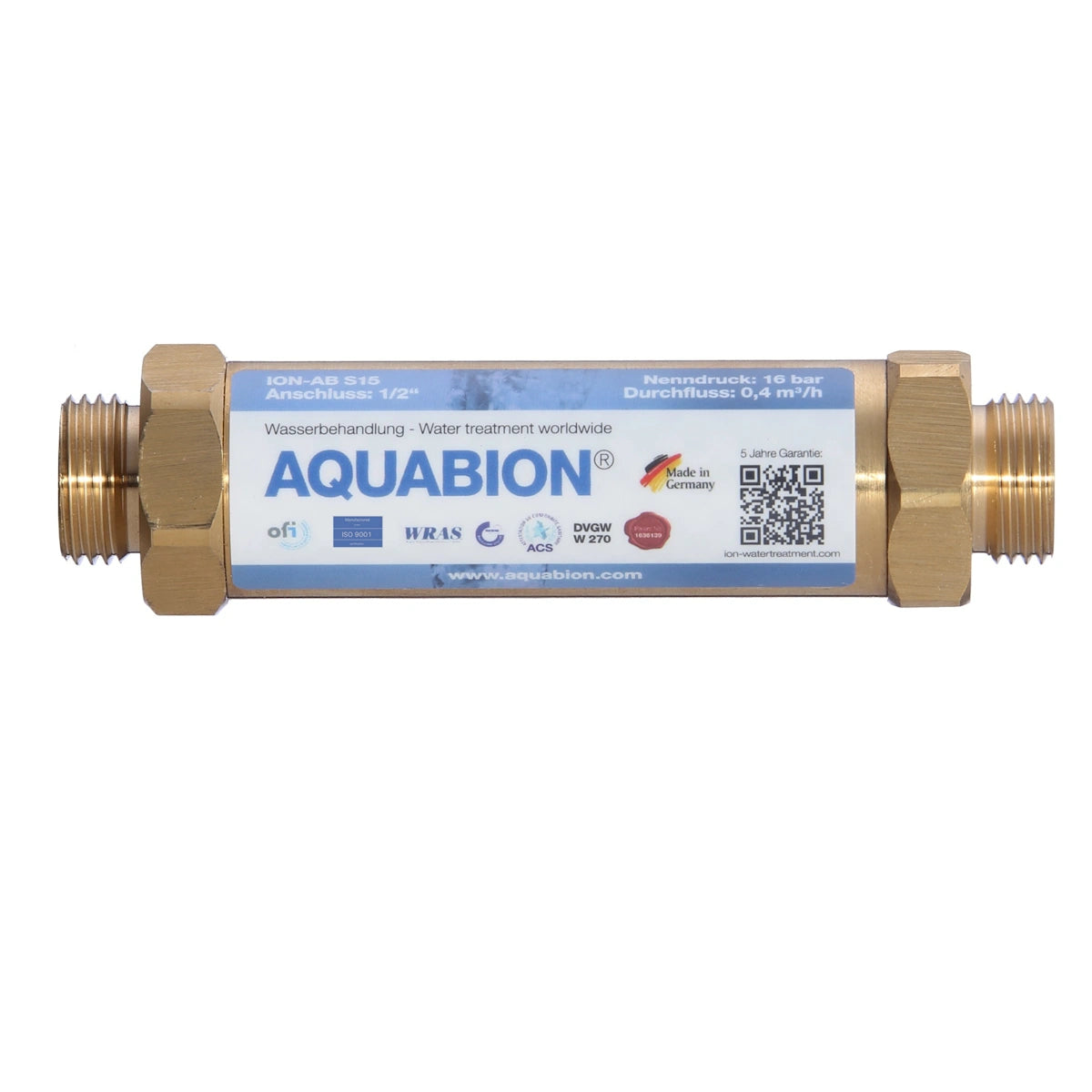
The ideal solution for homes with a 15mm (½") incoming mains supply and 1–2 simultaneous showers. 95–98% effective, zero maintenance, WRAS approved, 7-year service life. Made in Germany. 5-year manufacturer's warranty plus 1-year money-back satisfaction guarantee.
Designed for larger homes with a 22mm (¾") mains supply and up to 4 simultaneous showers. High-flow construction maintains optimal zinc ion contact time at peak demand. Same 7-year, zero-maintenance specification as the S15 — scaled correctly for larger households. Made in Germany.
Installation Guide: What Plumbers and Homeowners Need to Know
Aquabion S-series installation is a straightforward task for a competent plumber — most installs are completed in under two hours. There are no specialist tools required beyond standard compression fitting equipment. However, there are several critical requirements that must be followed for the unit to operate correctly and legally.

Where to Install
The unit must be installed as close to the incoming stop tap as possible — ideally immediately after it — on the cold mains supply entering the property. This ensures every litre of water entering the system is treated before it reaches any branching point, tap, appliance, or heating circuit. Installing downstream of any branch point means those branches will receive untreated water.
-
Identify and Confirm Pipe Size
Before ordering, confirm the diameter of the incoming mains pipe at the stop tap. 15mm = S15. 22mm = S20. Do not install an S20 on 15mm pipework without consulting Aquabion — the unit will be oversized and effectiveness will be compromised.
-
Isolate the Supply and Drain Down
Isolate the incoming mains at the stop tap and drain the section of pipework where the unit will be installed. Ensure the flow arrow on the unit body will point in the direction of flow before cutting the pipe.
-
Install Inline Using Compression Fittings
The unit accepts standard compression fittings (not included). Install the unit inline on the cold mains supply, respecting the flow direction arrow. The unit can be installed in any orientation — horizontal, vertical, or angled — provided flow direction is observed. Allow a straight pipe run of at least 150mm upstream where possible.
-
Connect the Earthing Cable and Straps
This is the most commonly overlooked step — and the most important. The supplied earthing cable and earthing straps must be connected as per the installation instructions. Two functions depend on this: the galvanic process itself requires an earth reference to operate correctly, and the connection is required to maintain electrical equipotential bonding continuity in accordance with BS 7671. Failure to connect earthing will compromise both performance and compliance.
-
Check for Metal Pipework Requirements
Install on metal pipework, or on plastic pipework with a minimum of one full pipe length of metal pipework both upstream and downstream of the unit. The galvanic process requires metal pipework contact for the electrochemical circuit to be complete. If the incoming supply is plastic throughout, confirm with Aquabion before installing.
-
Restore Supply and Check for Leaks
Restore the mains supply slowly and check all connections for leaks. The unit begins working immediately once water flows through it. No commissioning, set-up, or programming is required. The first signs of improvement — softer kettle deposits, cleaner shower screens — are typically noticed within 2–6 weeks.
For compatible boiler systems and central heating components, browse our range of scale inhibitors and water treatment products, or explore our boiler filters and gas combi boilers.
The Full Aquabion Range: From Domestic to Commercial
The S15 and S20 are the entry points into the Aquabion family — designed for the mains supply sizes found in the overwhelming majority of UK domestic properties. But Aquabion's galvanic technology scales across a comprehensive range of pipe sizes and applications, all sharing the same zero-maintenance, salt-free principles.


For property developers, BTL landlords, or HMO operators seeking whole-building protection, the H-series and F-series units provide the same galvanic technology at 1", 1¼", 1½", and 2" pipe sizes, with flanged DN65 versions available for large commercial installations. View the full Aquabion collection →
All Aquabion units can be paired with complementary scale and corrosion protection products from our scale inhibitors and water treatment range, including magnetic filters from ADEY for complete central heating system protection.
Notes for Heating Engineers and Tradespeople
Aquabion has become an increasingly common specification item on new build and retrofit heating projects across the UK — particularly as Part L building regulations push energy efficiency to the fore and client expectations around maintenance-free operation increase. Here are the practical considerations most relevant to trade specification.
Compliance Considerations
Installation on the cold mains supply requires connection of the supplied earthing cable and straps to maintain BS 7671 equipotential bonding continuity. This is a mandatory requirement — not an optional step. The earthing connection also completes the galvanic circuit that the unit's performance depends on. Include this in any installation record and Building Regulation notification where applicable.
Specifying Alongside Boiler Installations
The Aquabion S15 or S20 is an ideal upsell opportunity on any gas combi boiler or unvented cylinder installation in a hard water area — both categories of equipment are directly protected by whole-house mains treatment. Many manufacturers' warranties explicitly note that scale damage is not covered; installing Aquabion closes that risk for the client and reduces callback frequency for the installer. Warranty periods of 5 years on the Aquabion unit itself, combined with the product's 1-year money-back guarantee, make it a low-risk add-on for the client.
HMO and Multi-Dwelling Specification
For HMO licensees, BTL landlords, and housing associations, the H-series Aquabion units (H20 through H50) provide the same zero-maintenance galvanic protection at larger pipe sizes appropriate for communal mains supplies. The economics are compelling: a single H25 or H32 unit on the building mains supply provides whole-building protection with no ongoing service cost — compared to the alternative of managing scale-related maintenance calls across multiple flats or rooms. Request a trade quote for multi-unit or project orders →
Ready to Protect Your Home from Hard Water?
Browse the full Aquabion S-series and commercial range, or speak to our expert team to confirm the right unit for your property. Express UK delivery on all orders, with Klarna Pay in 3 available interest-free.