


Specific or complex project ahead? Get in touch for a free, fast quote.
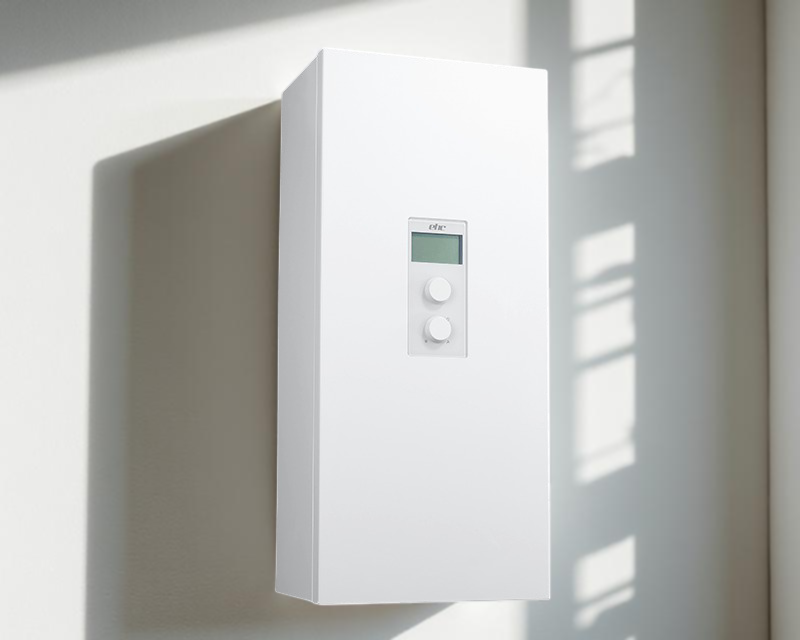


EHC Comet PV Electric System Boiler 3 Phase 24kW — Multi-Output 12 16 20 24kW Solar PV Integration App Control Three Zone
Regular price
£1,820.00
Inc. VAT
£1,516.67
Exc. VAT
FREE Express Delivery (1-3 days) in UK Mainland on most orders*
Excluding: Solar Panels (£170 delivery / free above £2,500), Batteries (£39 delivery), Small Items (£4.95/5.95 delivery / free above £500)
Contact Us to check for Next Working Day Delivery or Same-day Delivery options
Contact Us for Click & Collect options
Custom quote available on request
*See checkout or shipping policy for full details
Documentation
Downloads
Payment options
Tools & Kits
Build your kit
Need a full system?
Design your complete solution in minutes with our kit builders.
Do you have a question
about this product?
One of our expert advisors will be happy to help you!
Contact Us
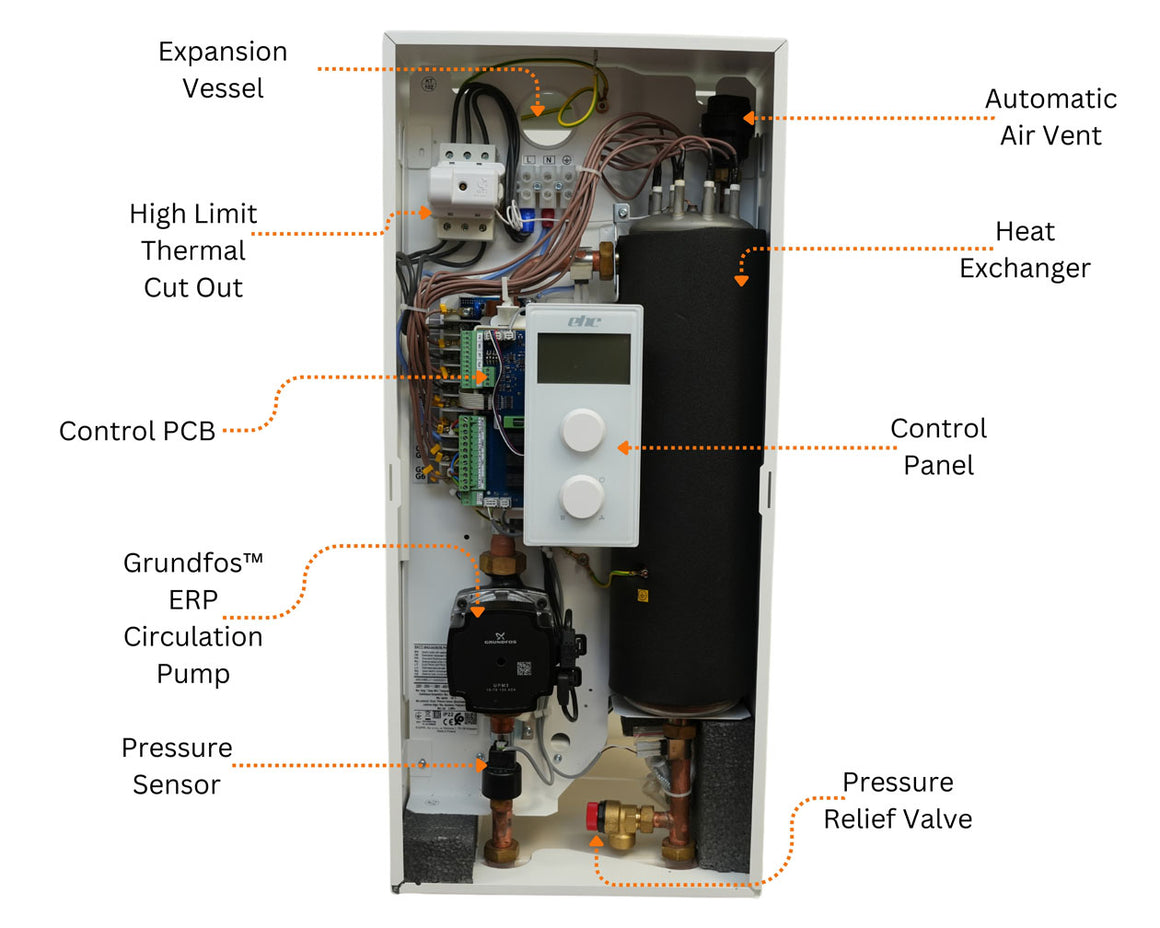
The EHC Comet PV Electric System Boiler (Model 3) is a three-phase 400V smart electric system boiler with four selectable output levels — 12, 16, 20 or 24kW — all configurable on-site at the point of installation. It operates as a full-featured standalone electric system boiler, and can additionally be integrated directly with a solar PV installation to maximise self-consumption of generated electricity. Up to three independent heating circuits can be managed simultaneously at different flow temperatures — for example underfloor heating, panel radiators, and a warm air unit — from a single boiler. The boiler features a stainless steel heat exchanger, weather compensation, automatic anti-legionella, frost protection, and 41 dB quiet operation. Remote management via smartphone is available with the EHC C.MI2 Internet Module (sold separately). Compatible with all hot water cylinders. 5-year warranty (registration required).
⚡ Three-Phase 400V Supply Required — Confirm with your DNO and electrician that a three-phase supply is available at the property before ordering. Maximum amp draw at 24kW is 3 × 34.6A requiring appropriate MCBs and cable sizing. Properties without three-phase should consider the single-phase Comet PV Model 1 (up to 8kW) or Model 2 (up to 14.4kW), or the Astro V2 combi range.
⚠ Qualified Installation Required — Must be installed by a Part P registered electrician. Always assess the property's incoming electrical supply capacity before specifying. This is a system boiler — it requires a separate hot water storage cylinder for DHW. Filling loop not supplied.
12–24 kW
On-site selectable
3 zones
Independent circuits
Solar PV
Direct integration
41 dB
Quiet operation
5 years
Warranty
Features & Benefits
✔ Solar PV Integration — Maximise Self-Consumption
The Comet PV's headline differentiator: it can be connected directly to a solar PV system to divert excess generated electricity into heating rather than exporting it to the grid at a lower SEG rate. When the PV system is producing more than the property's immediate demand, the boiler ramps up to absorb the surplus — heating water in the cylinder or running the heating circuit — making use of electricity that would otherwise earn only the Smart Export Guarantee tariff. This is particularly valuable for homes with larger PV arrays or battery storage already maximised.
✔ On-Site Multi-Output — 12, 16, 20 or 24kW
Rather than stocking four separate boiler SKUs, the Comet PV Model 3 is configured on-site at installation to the required output — 12, 16, 20 or 24kW — via the boiler's settings. This gives the installer complete flexibility to right-size the boiler to the property's actual heat loss calculation at the point of installation. If the property is upgraded (better insulation, extension), the output can be reconfigured without replacing the boiler. Load current ranges from 3 × 17.4A at 12kW up to 3 × 34.6A at 24kW.
✔ Three Independent Heating Zones
The Comet PV can manage up to three separate heating circuits simultaneously, each at a different flow temperature. A typical configuration might serve underfloor heating (35–45°C), panel radiators (55–65°C), and a warm air unit — all from the same boiler, without an additional mixing valve or separate controller per zone. This dramatically simplifies the installation of mixed systems and makes the Comet PV ideal for larger homes with multiple heating emitter types.
✔ App Control via EHC C.MI2 Module
With the optional EHC C.MI2 Internet Module (AHP1004), the Comet PV connects to the EHC app for full remote management — heating schedules, temperature adjustment, energy consumption monitoring, and system status — from a smartphone. The app interface is particularly useful for monitoring solar PV contribution to heating, allowing the homeowner to optimise self-consumption scheduling around their lifestyle. The internet module is sold separately.
✔ Weather Compensation
Weather compensation adjusts the boiler's flow temperature automatically in response to outdoor temperature — reducing flow temperature as the weather warms and raising it as it cools. This prevents the boiler from delivering high-temperature water on mild days (when it isn't needed), reducing cycling and improving system efficiency. Particularly effective combined with UFH, which responds well to lower, steadier flow temperatures, and when used with a solar PV system where running at lower output absorbs more PV generation over a longer period.
✔ Stainless Steel Heat Exchanger — Quiet & Efficient
The stainless steel heat exchanger is corrosion-resistant, long-lasting, and designed to eliminate unnecessary external pipework — all primary connections are made internally. The boiler operates at just 41 dB, quieter than a standard conversation, making it suitable for installation in living spaces, utility rooms adjacent to bedrooms, or open-plan properties without noise concerns. The large backlit LCD display provides clear on-unit feedback without requiring a connected device.
✔ Safety Features — Anti-Legionella & Frost Protection
Automatic anti-legionella cycling periodically raises the cylinder temperature to above 60°C to eliminate legionella bacteria — a regulatory requirement for domestic hot water systems. Built-in frost protection activates the boiler when the system temperature drops to a set threshold, protecting pipework and the cylinder in unoccupied or cold properties. Both functions operate automatically without user intervention.
✔ Compatible with All Hot Water Cylinders
As a system boiler, the Comet PV works with any indirect hot water cylinder — vented or unvented, standard or solar-compatible. For solar thermal integration, a twin-coil cylinder allows the solar circuit to pre-heat the DHW before the electric boiler tops up. For PV integration, a standard single-coil cylinder and immersion relay control is sufficient. DHW can be provided via S-Plan or Y-Plan wiring with the EHC twin channel heatpack.
Output Configurations — Model 3 (Three Phase)
| Output | BTU | Load Current |
|---|---|---|
| 12 kW | 40,945 BTU | 3 × 17.4 A |
| 16 kW | 54,594 BTU | 3 × 23.1 A |
| 20 kW | 68,243 BTU | 3 × 28.9 A |
| 24 kW | 81,891 BTU | 3 × 34.6 A |
Technical Specifications
| Manufacturer | EHC (The Electric Heating Company) |
| Model | Comet PV Model 3 — Multi-Output |
| Boiler Type | Electric system boiler (cylinder required for DHW) |
| Supply | Three phase 400V / 50Hz |
| Max Output | 24 kW (81,891 BTU) |
| Output Settings | 12, 16, 20, 24 kW — on-site configurable |
| Max Load Current | 3 × 34.6 A (at 24kW) |
| Flow Temperature Range | 20°C – 85°C (adjustable) |
| Heat Exchanger | Stainless steel |
| Heating Zones | Up to 3 independent circuits at different temperatures |
| Solar PV Integration | Yes — direct PV compatibility built in |
| App Control | Via EHC C.MI2 Internet Module AHP1004 (sold separately) |
| Weather Compensation | Yes |
| Anti-Legionella | Automatic |
| Frost Protection | Yes — automatic |
| Display | Large backlit LCD |
| Noise Level | 41 dB |
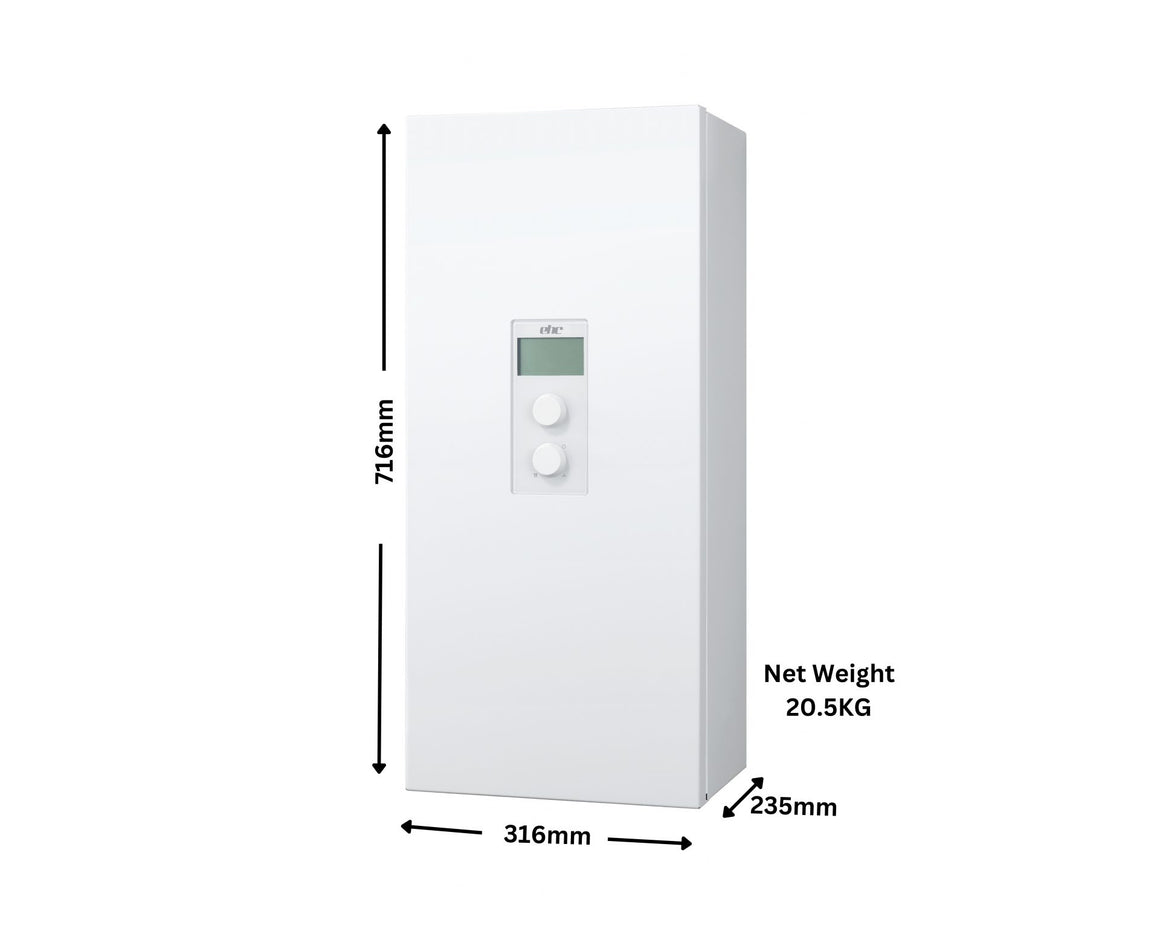
| Dimensions (H × W × D) | 716 × 316 × 235 mm |
| Cylinder Compatibility | All indirect hot water cylinders (vented and unvented) |
| Supplied With | Sensors, fixing jig (filling loop not supplied) |
| ERP Rating | D (heating) |
| Warranty | 5 years (registration required, T&Cs apply) |
Frequently Asked Questions
What is the difference between the Comet PV and the Astro V2?
The Astro V2 is a combi boiler — it produces central heating and instantaneous domestic hot water from one unit, with no need for a separate cylinder. It is best suited to smaller properties and is available in single-phase (12kW, 14.4kW) and three-phase (24kW) versions. The Comet PV is a system boiler — it heats the central heating circuit and an indirect cylinder for DHW storage. It is better suited to larger properties, multi-zone systems, and installations where a higher hot water demand requires stored DHW rather than instantaneous supply. The Comet PV's additional differentiators are built-in solar PV integration, three independent zone management, and app connectivity.
How does the solar PV integration work in practice?
The Comet PV connects to the property's solar PV system so that when generation exceeds immediate consumption, the surplus is directed into the boiler's heating elements rather than being exported to the grid. The boiler responds to a signal from the PV system or an energy monitoring device indicating available generation, and modulates its output accordingly. The result is that PV energy that would earn only the SEG export tariff instead displaces electricity that would have been purchased from the grid for heating — the effective value of self-consumed electricity is substantially higher than the export rate. EHC's app enables monitoring of PV contribution to heating over time.
Does the output need to be set at installation, or can it be changed later?
The output is configured via the boiler's settings and can be changed after initial commissioning if required — for example if a heat loss calculation is revised, if the property's insulation is improved, or if the system design changes. This flexibility is one of the key benefits of the multi-output design, and means the installer can stock a single boiler model rather than four separate SKUs. Output setting should be carried out by a qualified installer familiar with the boiler's commissioning procedure.
BTU & WATT Calculator
Room Dimensions
Room Type
Living Room
Bedroom
Kitchen
Bathroom
Conservatory
Hallway
Glazing Type
Single Glazed
Double Glazed
Triple Glazed
External Walls
0 Wall
1 Wall
2 Walls
3 Walls
4 Walls
Insulation Level
Poor
Average
Good (New Build)
Required Heating
0
Watts
0
BTUs
Documentation
Downloads
Tools & Kits
Build your kit
Need a full system?
Design your complete solution in minutes with our kit builders.
Do you have a question
about this product?
One of our expert advisors will be happy to help you!
Contact Us