


An instant water heater — also called an instantaneous, tankless or on‑demand water heater — produces hot water only when you open a tap. There is no cylinder, no preheating, and no standing heat loss. For UK homes with small utility rooms, flats without a traditional airing cupboard, annexes, off‑grid cabins and commercial washrooms, that changes the economics of hot water supply.
But “instant water heater” covers a very broad spectrum of equipment. A 3 kW handwash unit under a cloakroom basin and a 30 kW gas multipoint heater feeding an entire house are both instantaneous. They use different fuels, serve different applications, and require very different installation work. This guide breaks down every major category you’ll encounter in the UK market, explains the trade‑offs between gas and electric, and matches each type to its best use case — with real products, real flow rates, and honest limitations.
Key takeaways
- Instantaneous heaters eliminate standby heat loss, but flow rate is constrained by power rating and incoming cold‑water temperature.
- Gas multipoint units (24–30 kW) can supply a whole home at 14–16 L/min; single‑phase electric units handle one or two outlets.
- For a single kitchen tap, a small 10–15 L storage heater on a 13 A circuit often outperforms an instantaneous unit on the same supply.
- Correct sizing depends on simultaneous outlets multiplied by the UK winter temperature rise (~30°C).
“The single biggest sizing mistake we see is treating every instantaneous heater as a like‑for‑like swap. A 9.5 kW single‑phase unit will happily run a shower, but it cannot also run a kitchen tap at peak flow. Pick the heater around your outlets, not the other way round.”
— Quality Heating technical team
How an instant water heater works
The principle is the same whether the fuel is gas or electricity: a flow sensor detects that a tap has been opened, the heating element (or gas burner) fires, and cold mains water is heated as it passes through a heat exchanger. Hot water leaves the unit and travels straight to the outlet. When the tap closes, the heater stops. There is nothing being kept warm for later.
Flow detection
Opening a tap creates flow through the unit. A flow switch or turbine sensor detects this — typically from as little as 2.5 L/min — and signals the heater to fire.
Rapid heating
Cold mains water passes through a heat exchanger. In gas units, a modulating burner fires; in electric units, bare‑wire or enclosed elements energise in stages to match demand.
Temperature control
Inlet and outlet sensors feed into an electronic control board that modulates power output — increasing or decreasing energy delivery to maintain the set temperature as flow and inlet temperature vary.
Shutdown
Closing the tap stops flow, the heater de‑energises, and the unit enters standby drawing negligible power. No stored water means no reheat cycles during the day.
Gas vs Electric: the decision that drives everything else
Before you pick a brand or model, pick a fuel. The choice between gas and electric instantaneous heating determines your flow rate, your installation costs, your running costs, and where in the building the unit can go.
Gas instantaneous
High flow, whole‑home capable
- Typically 24–30 kW input — enough for 14–16 L/min at a usable temperature
- Runs natural gas (NG) or LPG; bottle‑fed LPG makes off‑grid installs viable
- Lower unit cost per kWh than electricity at current UK tariffs
- Requires a flue, room sealed combustion chamber, and a Gas Safe registered installer
- Best for kitchens, bathrooms and multipoint supply in properties without a boiler
Electric instantaneous
Compact, flueless, flexible siting
- No flue, no combustion, no annual gas safety inspection
- Single‑phase units up to ~13.5 kW; three‑phase up to 27 kW for whole‑flat supply
- Can be installed in cupboards, under sinks, bathrooms (with correct zoning) and loft spaces
- Higher running cost per kWh — offset by zero standing losses and point‑of‑use siting
- Best for single outlets, extensions, annexes, garden rooms, commercial washrooms
The five types of instant water heater
Within the broad “instant” category, UK‑specified equipment falls into five distinct product classes. Each is engineered for a different demand profile — mixing them up is where budgets blow out and performance disappoints.
Gas multipoint instantaneous
24–30 kW · 14–16 L/min
Wall‑mounted, room‑sealed units that supply multiple outlets — kitchen sink, bathroom, cloakroom — from a single appliance. Natural gas or LPG. The direct replacement for a combi boiler when space heating is handled separately (e.g. by electric radiators or a heat pump).
Best for: whole houses, multi‑bathroom flats, properties without a combi
High‑power electric multipoint
18–27 kW · requires 400 V supply
Three‑phase electric units matching gas‑level flow rates for properties off the gas grid. Typical UK domestic supply is single‑phase; a three‑phase connection must be confirmed with the DNO before specifying. Premium models use electronic closed‑loop control for precise ±1°C temperature stability.
Best for: whole flats and small houses with 3‑phase supply, off‑grid properties
Single‑phase electric multipoint
6–13.5 kW · standard UK domestic supply
The workhorse category. Single‑phase units rated 6–13.5 kW serve one or two outlets — a shower plus a handbasin, or a kitchen sink on its own. A 13 kW unit delivers roughly 4.5 L/min at 48°C with typical UK winter inlet temperatures, which is enough for a single generous shower.
Best for: en‑suites, extensions, small kitchens, utility rooms
Instantaneous electric shower
7–10.5 kW · single outlet
Dedicated shower‑only units with an integrated thermostat and a single hot outlet. Technically instantaneous heaters optimised for one application. The cheapest way to add a new shower anywhere in a UK property — no cylinder required, no pump, no gas.
Best for: second bathrooms, loft conversions, annexes, backup showers
Mini / handwash instantaneous
3–7 kW · point‑of‑use
Ultra‑compact units sized to supply a single hand basin at a hand‑washing temperature (35–40°C). Installed directly under or over the sink they serve — eliminating the long pipe runs and dead‑legs that waste water and energy in commercial washrooms and cloakrooms.
Best for: cloakrooms, WCs, offices, cafes, schools, retail
Micro electric combi boiler
4.8–9.6 kW · heating + DHW
A hybrid category: small electric units that combine space heating with instantaneous hot water in one chassis. They bridge the gap between a dedicated water heater and a full‑size combi boiler — ideal for small flats and studios where a gas connection is not available and heating demand is modest.
Best for: studios, small flats, granny annexes without gas
Application guide: which type for which job
The correct type depends on three things: how many outlets the unit must serve, whether those outlets run simultaneously, and your available fuel supply. Use the matrix below as a starting point — the sizing table further down will refine it.
| Application | Recommended type | Typical kW | Fuel |
|---|---|---|---|
| Whole house, 2+ bathrooms | Gas multipoint or 3‑phase electric | 27–30 kW | Gas / LPG |
| Flat, 1 bathroom + kitchen | Gas multipoint or 3‑phase electric | 18–24 kW | Gas Electric 3‑ph |
| En‑suite or extension (shower + basin) | Single‑phase electric multipoint | 11–13.5 kW | Electric 1‑ph |
| Shower only (no cylinder) | Instantaneous electric shower | 8.5–10.5 kW | Electric 1‑ph |
| Kitchen sink — dedicated | Small storage 10–15 L or single‑phase 6–9 kW | 2–9 kW | Electric 1‑ph |
| Cloakroom / WC basin | Mini / handwash instantaneous or 6 L undersink | 1.5–5 kW | Electric 1‑ph |
| Off‑grid cabin / holiday let | LPG multipoint or solar‑paired electric | 11–24 kW | LPG |
| Commercial washroom (multiple basins) | Multiple mini units (one per basin) | 3 kW each | Electric 1‑ph |
Featured instant water heaters
A curated selection from across the instant water heater range covering all five types. Prices include VAT. For the full range of 30+ models, see the collection page.

Biasi
Multipoint 16S 30kW Gas Instantaneous Water Heater
Italian‑built natural gas multipoint heater delivering 16 L/min at 80.5% thermal efficiency. Room‑sealed, 186 mm slim depth, digital LCD with 35–65°C setpoint. Supplied with horizontal flue and mounting kit.
£370.00 Inc. VAT

Ariston
Next Evo X 11 LPG Instantaneous Gas Water Heater
The LPG sibling of the Evo X range — 11 L/min output for off‑grid properties, holiday lets and rural homes. ErP A rated with oxygen‑free copper exchanger, ECO mode and low NOx lean‑rich burner. Ultra‑compact 165 mm depth.
£390.00 Inc. VAT

Stiebel Eltron
DHB-E 18/21/24kW — Three Phase Instant Water Heater
German‑engineered 3‑phase multipoint unit with selectable output (18/21/24 kW). 3i technology uses three electronic sensors to hold delivery temperature precisely between 20–60°C. Compact, flueless, suitable for undersink installation.
£595.00 Inc. VAT
Strom
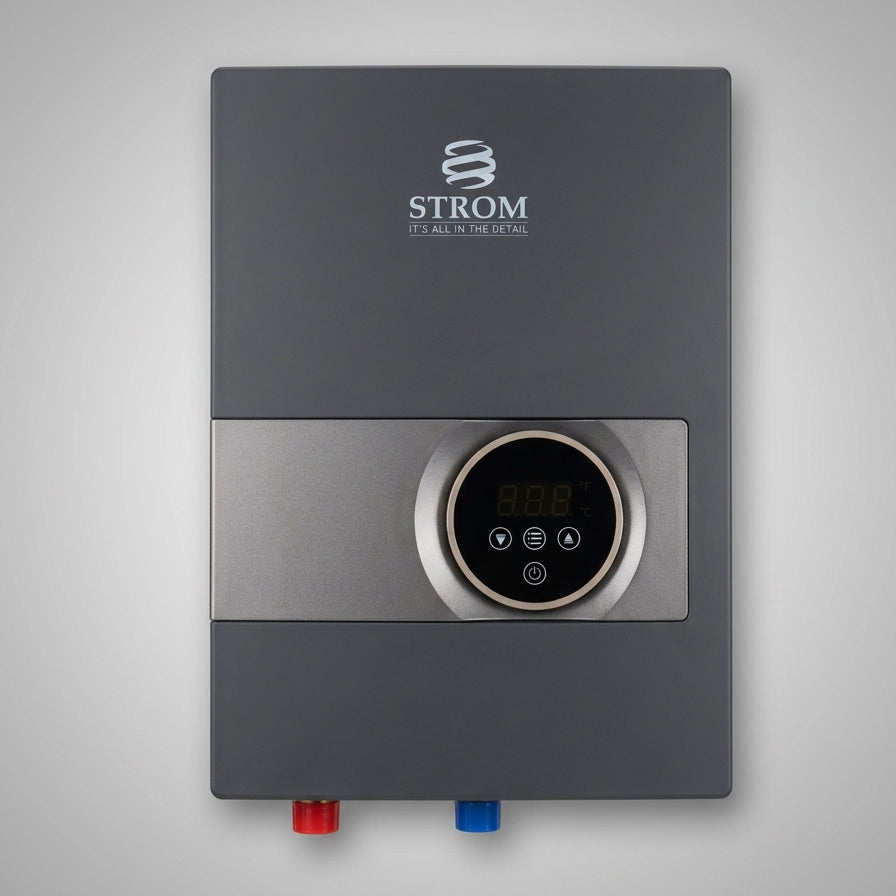
Touch Screen Single‑Phase Multipoint 9/11/13.5kW
A modern single‑phase multipoint with a touch‑screen display, switchable between 9, 11 and 13.5 kW. The 13.5 kW setting will run an en‑suite shower and a handbasin from one unit on a standard UK domestic supply — no 3‑phase required.
From £270.00 Inc. VAT

Ariston
Aures Multi 9.5kW Instantaneous Electric Water Heater
The value pick for a single‑outlet installation. 9.5 kW multipoint with integrated double‑pole ELCB for total electrical safety, and Good Design Award winner (2019). UK‑specified, compact enough for utility rooms, garages or small kitchens.
£115.00 Inc. VAT

Redring
Powerstream RPS95 9.5kW Instant Water Heater
A UK‑favourite single‑phase instantaneous unit, rated for 1–10 bar mains pressure with installation flexibility for under‑sink or wall mounting. 9.5 kW output, compact profile, proven Redring reliability — a strong value alternative to imported premium units.
£139.00 Inc. VAT

Veito
Speed E Instant Water Heater / Shower 8.3kW
A dedicated instantaneous shower unit at 8.3 kW — the cheapest way to add a working shower to a loft conversion, annexe or second bathroom without a cylinder. Single outlet, integrated thermostat, simple single‑phase install.
£175.00 Inc. VAT

Redring
RMHW3 3kW Manual Instant Hand Wash Unit
A 3 kW over‑basin handwash unit for cloakrooms, WCs and commercial washrooms. Energy rated A, manual control, designed for direct point‑of‑use installation — zero pipe dead‑legs, zero standing losses on circuits where hot water is rarely drawn.
£99.00 Inc. VAT
When small storage beats instantaneous: undersink & oversink options
The instant water heaters collection includes the Ariston Andris Lux range of small undersink and oversink water heaters. Strictly speaking, these are small storage heaters with a 6–30 L insulated tank — not truly instantaneous. But they solve exactly the same point‑of‑use problem, and for several common UK scenarios they are a better answer than a genuinely tankless unit.
Why we include them in this guide
An instantaneous heater’s flow rate is dictated by its power rating and the cold‑inlet temperature. On a standard 13 A single‑phase socket you get ~3 kW — which gives roughly 1.1 L/min at winter UK mains temperatures. That’s fine for hand‑washing but hopeless for filling a washing‑up bowl. A 15 L storage unit on the same 13 A socket can deliver 8–10 L/min of hot water on demand — until the tank empties. For bursty kitchen use, that trade‑off wins.
Small storage vs instantaneous for a single outlet
| Factor | Small storage (15 L, 3 kW) | Instantaneous (3–5 kW) |
|---|---|---|
| Peak flow at 40°C | 8–10 L/min until tank depletes | ~1.1–2.3 L/min (sustained) |
| Recovery after burst | ~15–25 min reheat | Instant — no recovery needed |
| Power supply | Standard 13 A fused spur | 13 A for small units; dedicated radial for 6 kW+ |
| Best use case | Bursty demand — washing up, kitchen tap | Continuous low flow — handwashing, light use |
| Standing heat loss | Small but non‑zero (insulated tank) | Zero |
| Installation cost | Lower — plug‑in or simple spur | Lower for small units; higher once above ~6 kW |
Undersink vs oversink: which orientation?
Undersink units mount in the cabinet beneath the basin, connected to the same cold feed that serves the cold tap. A dedicated mixer tap is usually required. Choose this when cabinet space is available and you want the unit out of sight.
Oversink units mount on the wall above the basin with their outlets feeding down into the sink — typically with a matched hob‑style hot tap. Choose this when there is no usable cabinet (e.g. butler sinks, pedestal basins, outdoor or utility installations) or when you want the easiest possible maintenance access.
Sizing is demand‑led. A 6 L unit suits a single handbasin; 10–15 L suits a kitchen sink with occasional burst demand; 30 L suits a kitchen used for cooking and washing up where you want the tank to refill during a task, not after it.

Ariston
Andris Lux 6L Undersink 1.5kW
The smallest unit in the range — sized for a single cloakroom basin. Plugs into a standard 13 A socket, no dedicated circuit required. 6 L insulated tank means you get instant hot water at the tap without waiting for a long pipe run to purge.
£115.00 Inc. VAT

Ariston
Andris Lux 15L Undersink 3kW
The sweet spot for a single kitchen sink. 15 L reheat capacity at 3 kW handles washing‑up demand without the flow limitations of a pure instantaneous unit. Wall‑mounted in the sink cabinet, connects to the existing cold feed.
£175.00 Inc. VAT

Ariston
Andris Lux 15L Oversink 3kW
The same 15 L / 3 kW capacity as the undersink unit, mounted above the basin for installations where there’s no usable cabinet — butler sinks, pedestal basins, utility rooms or outbuildings. Pairs with a matched hob‑style hot tap.
£175.00 Inc. VAT

Ariston
Andris Lux 30L Oversink 3kW
The largest in the range — 30 L of storage for kitchens with sustained demand (cooking, washing up, cleaning) or light shower backup in a utility/annexe. Supplied with install kits A, B or C to match the specific plumbing configuration on site.
£430.00 Inc. VAT
Sizing: kW, flow rate and temperature rise
The central equation for any instantaneous heater is the relationship between power, flow rate and temperature rise. UK cold mains sits around 8–10°C in winter and 15–17°C in summer. A shower needs ~40°C, so in January a heater has to lift the water by around 30°C — a bigger ask than most specifications acknowledge. Use this table to sanity‑check any unit against the outlets it needs to serve.
| Unit rating | Flow @ 30°C rise | Flow @ 38°C rise | Suitable outlets |
|---|---|---|---|
| 3 kW | ~1.4 L/min | ~1.1 L/min | 1 handbasin (hand‑wash only) |
| 6 kW | ~2.8 L/min | ~2.3 L/min | 1 kitchen sink or 1 basin |
| 9 kW | ~4.3 L/min | ~3.4 L/min | 1 low‑flow shower OR 1 sink |
| 13 kW | ~6.2 L/min | ~4.9 L/min | 1 shower + 1 basin (sequential) |
| 18 kW | ~8.6 L/min | ~6.8 L/min | 1 bathroom + kitchen (sequential) |
| 21 kW | ~10.0 L/min | ~7.9 L/min | 1 bathroom + kitchen (near‑simultaneous) |
| 24 kW | ~11.5 L/min | ~9.1 L/min | 2 bathrooms (sequential) |
| 27–30 kW | ~13–14.3 L/min | ~10.2–11.3 L/min | 2 bathrooms + kitchen (simultaneous) |
Figures are theoretical maxima assuming 100% useful heat transfer. Real‑world flow rates are typically 5–10% lower due to heat losses and mains pressure constraints. All flows calculated on the standard heat transfer equation (Q = m · c · ΔT) where water’s specific heat capacity is 4.186 kJ/kg·°C.
Related equipment & alternatives
Instant water heaters don’t exist in isolation. Depending on your demand profile and existing infrastructure, one of these adjacent product categories may be a better fit — or a useful companion.
Storage water heaters
For larger simultaneous demand on a single‑phase supply, a full‑size unvented cylinder typically outperforms any instantaneous heater.
Browse storage heaters →Electric showers
A subset of instant heaters built specifically for shower‑only applications, with integrated controls and showerhead.
Browse electric showers →Gas combi boilers
If you need space heating too, a combi boiler does both jobs in one appliance — often the most efficient choice for whole‑house installs.
Browse combi boilers →Heat pump water heaters
For properties prioritising long‑term running costs and decarbonisation, a heat pump water heater delivers the lowest operating cost per litre.
Browse heat pump water heaters →UK compliance & standards
Not sure which instant heater suits your project?
Our technical team sizes instantaneous systems every day — from single‑cloakroom handwash units to 3‑phase whole‑flat installations. Tell us your outlet count, flow demands and fuel options; we’ll come back with a short list.
Further reading: Water Heaters Buying Guide · Water Heaters FAQs · How to Install a Mains Pressure Water Heater