


Most home batteries stop working properly when the temperature drops. They lose capacity, refuse to charge below zero, and in an unheated garage or outbuilding — exactly where many people want to put them — they quietly degrade all winter. The Eleven Energy Galvani is built on a fundamentally different chemistry, one that doesn't share that limitation.
Sodium-ion technology has been in development for decades, but 2025 marked a genuine turning point: commercial systems are now available, competitively priced, and performing in real UK installations. This guide explains how sodium-ion cells work, why the chemistry matters for British winters, and how the Galvani's stackable format lets you build from 4.5 kWh all the way to 18 kWh without ever replacing the system you started with.
What Is Sodium-Ion Technology? A Plain-English Explainer
All modern rechargeable batteries work on the same basic principle: ions shuttle back and forth between two electrodes through an electrolyte, and that movement stores or releases electrical energy. Lithium-ion batteries use lithium ions. Sodium-ion batteries use sodium ions instead. Both processes are chemically similar — the critical differences lie in what those ions are made of, how they behave at the extremes, and where they come from.
Sodium is element 11 on the periodic table — lightweight, highly reactive, and one of the most abundant elements on Earth. It is extracted commercially from seawater and soda ash in vast quantities. Unlike lithium, it requires no contested mining in ecologically sensitive regions.
During charging, sodium ions move from the cathode to the anode. During discharge they return. This is structurally identical to lithium-ion, but sodium's larger ionic radius requires different electrode materials — and those materials don't depend on cobalt or scarce lithium.
Lithium-ion electrolytes become sluggish and unsafe below 0°C. Sodium-ion chemistry maintains ionic conductivity at significantly lower temperatures, which is why the Galvani charges down to −20°C — a practical and important advantage in the UK.
Lithium-ion batteries can experience thermal runaway — a self-amplifying heat reaction that causes fire and explosion. Sodium-ion cells are inherently more thermally stable, with a significantly lower risk of runaway, which changes the installation risk profile for indoor and outdoor use.
The Faraday Institution — the UK's leading battery research body — notes that sodium-ion batteries are "attractive prospects for stationary storage applications where lifetime operational cost, not weight or volume, is the overriding factor." That describes home energy storage precisely: you're not flying with it, you're mounting it on a wall. The UK is also home to early-stage domestic sodium-ion manufacturing efforts; in late 2025, researchers at Batri and Swansea University produced what is believed to be Europe's first sodium-ion cell made entirely from UK-sourced materials, using Welsh coal-derived carbon — a signal of how seriously the country is taking this technology.
Sodium-Ion vs Lithium-Ion (LFP): What Changes for UK Home Storage
When most installers and homeowners compare home batteries, they're weighing sodium-ion against LFP (lithium iron phosphate) — the current gold standard for residential storage. Here's how the Galvani stacks up on the factors that matter most in a UK context.
| Factor | Galvani (Sodium-Ion) | Typical LFP Battery |
|---|---|---|
| Minimum charge temperature | −20°C ✓ | 0°C to +5°C |
| Minimum discharge temperature | −30°C ✓ | −10°C (reduced capacity) |
| Cobalt content | None ✓ | None (LFP-specific) |
| Lithium content | None ✓ | Yes — requires mining |
| Thermal runaway risk | Lower ✓ | Low (better than NMC) |
| IP65 outdoor rating | Yes — module & junction box ✓ | Varies — many require shelter |
| Depth of discharge (on-grid) | 92% ✓ | 80–90% (typical) |
| Unheated garage suitability | Yes — year-round ✓ | Risk of degradation in winter |
| Stackable / modular | Yes — up to 4× (18 kWh) ✓ | Some models |
| Sodium source | Seawater / soda ash ✓ | Brine / salt flats (Atacama) |
Cold-climate testing in early 2026 showed unheated garage installations in Edinburgh maintaining full sodium-ion charge cycles through extended cold snaps, while neighbouring LFP systems struggled or stopped charging entirely during freezes. The difference isn't marginal — it can mean weeks of interrupted storage per winter.
How the Galvani Stack System Works
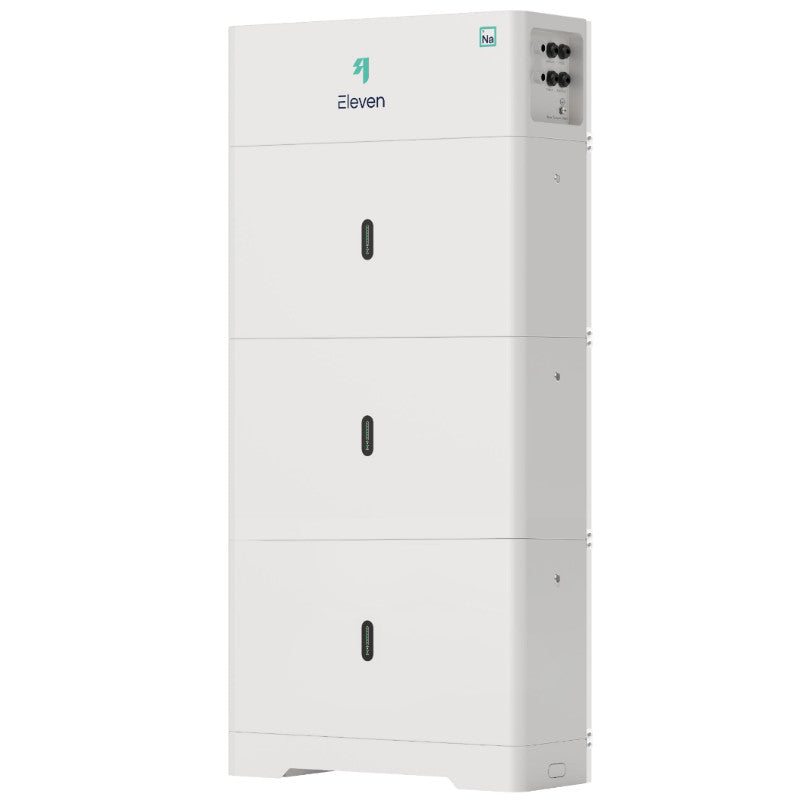
The Galvani is designed as a modular, vertical-stacking system. Each battery module sits on top of the previous one, connecting mechanically via interlink brackets and electrically via the junction box. Understanding the full configuration before ordering is important — the Base and Junction Box is a mandatory separate purchase for every stack, not an optional add-on.
4.5 kWh
4.5 kWh
4.5 kWh
4.5 kWh
What you need for a single-module starter system:
- 1× Galvani 4.5 kWh Battery Module
- 1× Galvani Base & Junction Box (required for every stack)
- 1× Eleven Energy Hybrid Inverter (mandatory — no third-party inverter compatibility)
Adding capacity later: Buy additional battery modules and stack them vertically — up to 4 per stack. One Base & Junction Box covers the whole stack, so you only ever need one per stack. The datasheet also references future support for up to 16 modules in parallel configurations (up to 66.24 kWh usable), enabled via a forthcoming parallel cable accessory not yet available at time of writing.
Communication: RS485 IN/OUT ports on each module handle inter-module communication within the stack. The junction box contains the pre-installed 35mm² power cable (2m) for connecting to the inverter, plus data cables, waterproof glands, grounding cable, wall mount brackets and adjustable feet.
The Galvani is exclusively compatible with Eleven Energy Hybrid Inverters. It cannot be connected to GivEnergy, Fox ESS, SolarEdge, SolaX, Growatt, Sungrow or any other brand's inverter. This is a hardware and firmware requirement, not a configuration option. Always specify the complete Eleven Energy inverter and battery system together when planning your installation.
Why Cold Weather Performance Matters in the UK
The UK's energy storage market has largely been built around the assumption that batteries live in heated utility cupboards or warm conditioned spaces. That's fine for a terraced house in London — but it rules out a huge proportion of available installation locations: unheated garages, detached outbuildings, garden rooms, barns, and outdoor enclosures.
LFP batteries typically stop accepting a safe charge below 0°C and begin degrading measurably below 5°C. A battery installed in an unheated garage in January 2026 in Glasgow — where overnight temperatures regularly reach −5°C to −10°C — simply doesn't charge for part of the night, defeating the purpose of off-peak tariff optimisation. Some manufacturers offer heating mats or thermal management systems as workarounds, but these add cost, complexity and consume energy themselves.
The Galvani's sodium-ion chemistry charges down to −20°C and discharges down to −30°C, combined with IP65 ingress protection. It can be mounted on an exterior wall, inside a timber-framed outbuilding without a concrete floor, or in a garden cabinet — without any supplementary heating or weather enclosure. The installation manual simply requires the mounting wall to be fire-resistant with a minimum thickness of 100mm.
Sodium-Ion in 2025–26: What the Industry Is Saying
Sodium-ion storage has moved from academic literature to real commercial product in the space of two years. Here's what's happening across the industry right now.
CATL confirms scale-up. The world's largest battery manufacturer confirmed significant upgrades to its sodium-ion product range heading into 2026, predicting "sodium and lithium batteries shining brightly together" in the global market — a major endorsement of the chemistry's commercial readiness.
Europe's first fully domestic Na-ion cell. Researchers at Batri and Swansea University produced a cylindrical sodium-ion cell using 100% UK-sourced materials, including Welsh coal-derived carbon anode. The milestone was hailed as proof that sovereign sodium-ion battery production is viable in the UK today.
UK takes lead role. The Faraday Institution's NEXGENNA project is specifically accelerating sodium-ion commercialisation with UK companies. The institution notes the UK is "an established leader in the field" and calls for investment to maintain that position ahead of accelerating international competition.
Warm Homes Plan expansion. Reports in early 2026 suggest the UK government's Warm Homes Plan may expand to cover battery storage installations — potentially offering £1,500–£2,500 grants for eligible households. This would substantially alter the payback calculation for sodium-ion systems already priced competitively against lithium alternatives.
The Galvani System: Battery Module & Base / Junction Box
The complete Galvani system requires both items below. The junction box is not optional — it is the electrical and mechanical interface between your battery stack and the Eleven Energy inverter, and one is required per stack regardless of how many modules you install.

Full Technical Specifications
All data from the Eleven Energy Galvani Stackable Battery Datasheet V1.0 (December 2025).
| Electrical | |
| Battery Type | Sodium-ion (Na-ion) |
| Model | ELB-4.5-02 (Galvani) |
| Nominal Capacity | 4.5 kWh per module / 18 kWh per stack (×4) |
| Rated Voltage | 45 V |
| Operating Voltage Range | 33 V – 59.2 V |
| Max Charging Current | 100 A (single module) / 200 A (multi-module stack) |
| Max Discharging Current | 100 A (single module) / 200 A (multi-module stack) |
| Depth of Discharge | 92% on-grid / 95% off-grid |
| Communication Interface | RS485 / CAN |
| Power Cable (pre-installed) | 35 mm², 2 m (in Junction Box) |
| Environmental | |
| Charging Temperature Range | −20°C to +55°C |
| Discharging Temperature Range | −30°C to +55°C |
| Humidity Range | 5% – 95% |
| IP Rating | IP65 (module and junction box) |
| Physical — Battery Module | |
| Dimensions (W × H × D) | 640 × 350 × 250 mm |
| Weight | 59 kg |
| Physical — Junction Box & Base | |
| Junction Box Dimensions | 640 × 220 × 250 mm / 11.5 kg |
| Base Dimensions | 640 × 80 × 250 mm / 6 kg |
| Compliance & Warranty | |
| Standards | EN IEC 61000-6, EN IEC 62619 |
| Product Warranty | 10 years |
| Inverter Compatibility | Eleven Energy Hybrid Inverters only |
Who Is the Galvani Best Suited For?
The Galvani's particular combination of features makes it stand out in specific installation scenarios that other batteries handle poorly. It's worth being direct about this: if you have a warm, climate-controlled indoor wall space and a popular LFP-compatible inverter already installed, the Galvani may not be your first choice. But for the following situations, it makes compelling sense.
Unheated detached garages and outbuildings. This is the Galvani's clearest competitive advantage. If your best installation location doesn't stay above 0°C in winter — and most uninsulated UK garages don't — sodium-ion is the only chemistry that works without supplementary heating. Combined with IP65, it can even go on an exterior wall under a porch or overhang.
Off-grid and near-off-grid rural properties. Farmhouses, rural retreats and properties with unreliable grid connections often have high instantaneous load demands — water pumps, immersion heaters, power tools. The Galvani's 200A multi-module discharge current handles these loads well, and the 95% off-grid DoD means very little capacity is left unused per cycle.
New solar installations where sustainability credentials matter. For homeowners and developers who place weight on supply chain ethics — no contested mining, no cobalt — sodium-ion is the cleaner choice by a clear margin. If you're already investing in solar panels to reduce your carbon footprint, the battery chemistry arguably should matter too.
Phased installations with future expansion in mind. Start with one 4.5 kWh module and add more later. The modular stacking format means your initial investment in the Base and Junction Box isn't wasted when you scale up — and future parallel stacking (when the parallel cable accessory is released) will allow well beyond 18 kWh in a single installation.
Related Products & Guides
Frequently Asked Questions