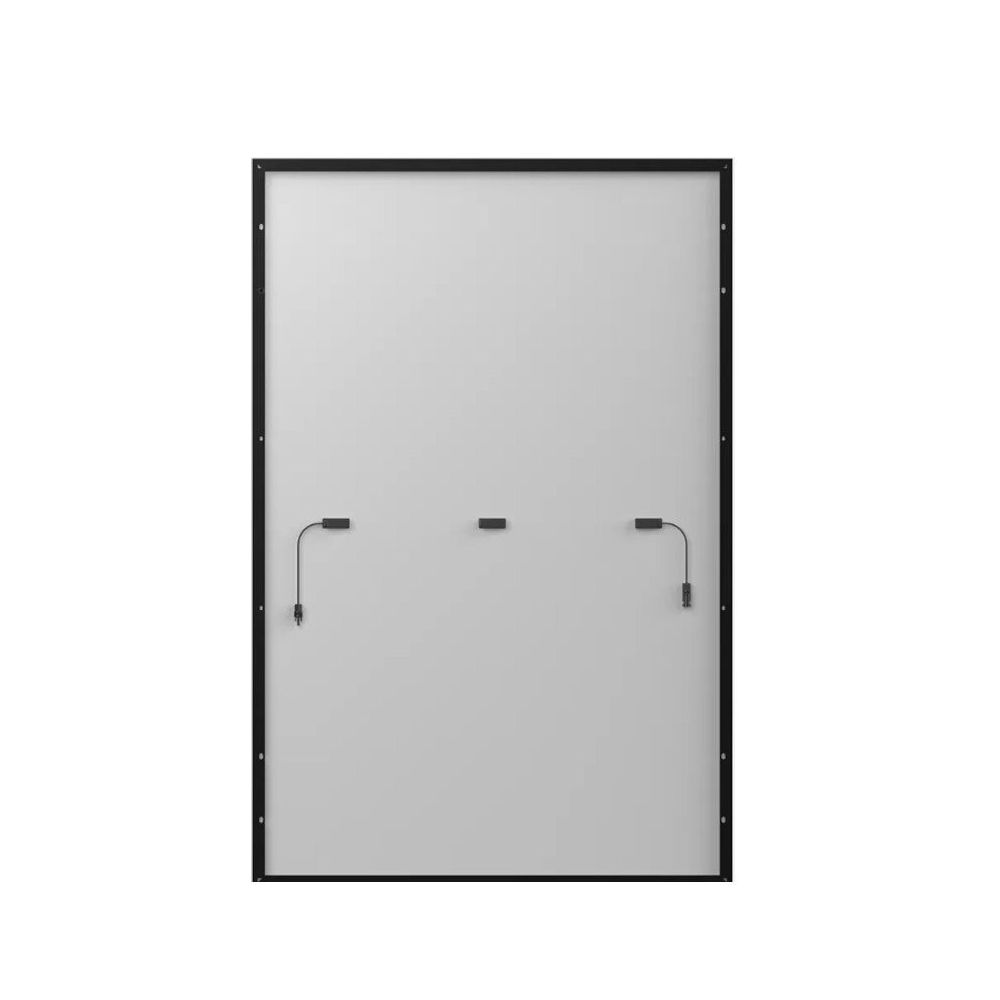
✔ N-Type ABC — No Front Grid Losses
All Back Contact (ABC) architecture moves every electrical contact to the rear of the cell, eliminating the front metal grid that shades conventional panels. This means every mm² of cell area contributes to generation, enabling the 23.3% module efficiency. ABC cells also resist Light Induced Degradation (LID) — a key long-term yield advantage of N-type over P-type panels.
✔ Best-in-Class Temperature Coefficient
At –0.26%/°C, the Neostar 2S loses significantly less output on hot days than standard PERC panels (typically –0.33 to –0.38%/°C). On a 35°C summer day, a panel operating at 60°C surface temperature loses approximately 10% output on a standard panel vs approximately 7% on this panel — a meaningful real-world yield difference over a year of UK generation.
✔ Cell-Level Partial Shade Optimisation
Aiko's ABC architecture provides cell-level partial shading optimisation — unique in the industry at this scale. Rather than the entire string suffering when one cell is shaded, output loss is contained to the shaded cells only. This is particularly valuable on UK rooftops where chimneys, aerials, and neighbouring buildings create partial shading during morning and afternoon hours.
✔ Gen 2 — Higher Power, Lower BOS
The second-generation Neostar 2S increases per-panel power output and reduces Balance of System (BOS) cost per kWp installed — fewer panels, fewer mounting components, fewer cable connections, and less roof penetration to achieve the same system kWp. The range spans 440W–470W so the 465W variant sits at the high end of the production bin.
✔ Excellent Low-Light Performance
ABC cell architecture produces strong output at low irradiance — important for UK conditions where diffuse cloud-light generation makes up a substantial proportion of total annual yield. The absence of front grid shading means cells respond efficiently at low light levels that would produce minimal output from heavily gridded conventional cells.
✔ Micro-Crack Resistant — Roof Safety
Aiko's ABC modules incorporate enhanced micro-crack resistance compared to conventional P-type cells. Micro-cracks from transportation, installation, and thermal cycling are a leading cause of long-term degradation and hot-spot fires in older panel designs. The front-grid-free design also removes the main cause of localised heating that triggers fire safety concerns in high-pitch installations.
✔ Sleek All-Black Aesthetic
Black anodised aluminium frame, all-black backsheet, and bezel-free edge give the Neostar 2S a uniform, uninterrupted black appearance from the street. ABC technology's rear-contact design means there are no visible silver grid lines on the cell face — the result is a completely unbroken dark surface that planning authorities, architects, and homeowners consistently prefer over conventional panel aesthetics.
✔ 30-Year Performance Warranty
Aiko guarantees ≤1% degradation in year 1 and ≤0.35%/year thereafter — meaning the panel will produce at least 87.4% of its rated output after 30 years of operation. The 30-year performance warranty extends beyond the useful life of most inverters and batteries, reflecting Aiko's confidence in the long-term stability of ABC cell chemistry.
✔ Flexible Clamp Positions
The panel frame supports clamping on both the long and short sides, giving installers flexibility to use portrait or landscape mounting orientations with standard mid-clamp and end-clamp hardware. Compatible with all major UK mounting systems (GSE, K2, Schletter, IronRidge). Stäubli MC4 EVO2 connectors are fitted as standard for compatibility with string inverter and optimiser wiring systems.
STC = Standard Test Conditions: 1000 W/m², AM1.5 spectrum, cell temperature 25°C.
What makes ABC technology different from standard N-Type TOPCon panels?
Both ABC and TOPCon are N-type cell technologies and both outperform conventional P-type PERC in efficiency and LID resistance. The key difference is contact placement: TOPCon cells still have a front metal grid which shades a proportion of the cell area and limits efficiency. ABC moves all contacts to the rear, eliminating front shading entirely and allowing the full cell surface to generate current. This is why the Aiko Neostar 2S achieves 23.3% module efficiency — significantly above the 21–22% typical of TOPCon panels at the same wattage. The trade-off is that ABC manufacturing is more complex and currently costs more per watt to produce.
How does the 23.3% efficiency translate to roof space requirements?
The 1,757 × 1,134mm panel occupies approximately 1.99 m² of roof area and produces 465W — giving 23.3W per 100cm², or roughly 233W per square metre of panel area. A 4kW system (approximately 8–9 panels) would occupy around 16–18 m² of roof, compared to 20–22 m² for a conventional 21% efficiency panel achieving the same 4kW. This is meaningful on rooftops with limited south-facing area, chimney stacks, or Velux windows reducing the usable roof zone.
Is it compatible with optimisers and microinverters?
Yes — the Stäubli MC4 EVO2 connectors are compatible with standard string inverter wiring, as well as Tigo, SolarEdge, SMA, Huawei, and other optimiser systems. The panel's high Voc (41.12V) and Impp (13.41A) characteristics are within the input specifications of all major UK residential inverters. For shaded rooftops, the panel's built-in cell-level shade optimisation already provides significant shade mitigation — additional optimisers may still be worthwhile where shading is severe and consistent.
Why does the Neostar 2S 465W have two slightly different efficiency figures cited (23.3% and up to 23.6%)?
The Neostar 2S range covers 440W–470W in production. The 23.3% figure is the module efficiency for the 465W variant specifically — based on the panel's rated output (465W) divided by its total area (1.99m²). The 23.6% figure refers to the top-binned 470W variant within the same production range. When comparing this panel to competitors, always use the 23.3% figure for the 465W product, not the 23.6% range maximum.